
Philadelphia's Split Clerk Structure
Most states route court filings through one clerk. Philadelphia spreads the work across offices, which trips up people used to a single counter. The First Judicial District's Office of Judicial Records performs prothonotary and clerk functions for many Court of Common Pleas and Municipal Court matters. The elected Register of Wills is a separate office that also serves as Clerk of the Orphans' Court for marriage licenses, probate, estates, and Orphans' Court dockets. So the answer to "where is the clerk" depends entirely on the record you want.
This split is why the same county can feel like it has two clerks. Civil and criminal court records flow through the Office of Judicial Records and the court portals. Marriage and probate records flow through the Register of Wills. Getting this right the first time avoids a wasted trip across City Hall.
The vocabulary adds to the confusion. Other states use "prothonotary," "county clerk," or "district clerk," and people often search for those titles in Philadelphia. In practice, many court filing and record functions flow through the First Judicial District and the Office of Judicial Records, while marriage and probate flow through the Register of Wills and Clerk of the Orphans' Court. Mentioning both offices early, as this page does, helps a reader avoid requesting a marriage certificate from the wrong place or a civil docket from the Register.
What the Office of Judicial Records Handles
The Office of Judicial Records is the filing and record office for many First Judicial District matters. It supports Common Pleas and Municipal Court filings, processes court records and access requests, and even accepts passport filings. Court records are reached through the Calendars & Case Information page, the UJS portal, the FJD e-filing and public access systems, and the public-request procedures set by court policy.
One detail worth checking before relying on it: the FJD page reviewed listed civil, criminal, and Orphans' Court e-filing as not available at the time, so confirm current e-filing status before claiming you can file a given case online. The office handles the records side; it does not give legal advice.
For day-to-day searches, the office's records connect to the public portals rather than a single in-house database. Civil dockets are reachable through the City civil case docket search and the FJD systems, criminal dockets through the statewide UJS portal, and traffic matters through the Municipal Court Traffic Division. The Office of Judicial Records becomes the place to go when a record is not online, when you need a certified copy, or when you need to correct a clerical error in a case file. Those tasks require a person at a counter, not just a web search.
The correction process is itself a useful function. Under the public-access policy, a party or attorney who finds a clerical error can submit a written request to the proper custodian, with the alleged error and supporting facts. The custodian should respond within ten business days or state that up to thirty more business days are needed. That gives people a formal route to fix a mistake on their own record rather than living with it.
How to Request a Certified Copy
A certified copy is an official copy the court stamps for use in legal matters. An uncertified printout from an online docket is not the same thing and may not be accepted in court. The steps below outline the general path for a Philadelphia court record.
- Identify the case number and the court, since the office needs both to find the file.
- Confirm whether the record is held by the Office of Judicial Records or the Register of Wills.
- Make the request to the proper custodian; a simple record can often be requested orally.
- Pay the posted copy and certification fee for the pages you need.
- Pick up the certified copy or arrange delivery as the office directs.
Under the statewide policy, complex or large requests may need a written request that describes the records, and a written denial must explain its reason. The certified-copy step matters most for legal use. A bank, a court in another case, or a government agency usually wants the certified version, with the court's stamp, not a screenshot of an online docket. So if you are gathering records for a legal purpose, plan for the copy fee and the certification rather than relying on a free printout. For everyday reference, the free online docket is usually enough.
Court Record Request Fields
When you search or request a court record, a few core fields drive the process. The table lists the fields used on the First Judicial District case-record search and request workflow.
| Field Label | Type | Required | Notes / Format |
|---|---|---|---|
| Case number | Text | Conditional | Used by civil docket and docket-specific systems |
| Plaintiff name | Text | No | Civil docket service allows a plaintiff search |
| Defendant name | Text | No | Civil docket service allows a defendant search |
| Court / docket type | Link / tab | Yes | Civil, family, Orphans' Court, Municipal, or UJS criminal |
| Date filters | Date | No | Available through calendar links |
Court Records Fees
Fees depend on what you need and which office holds the record. Viewing a file at the courthouse should be free under the statewide policy. Copies and certified copies carry posted charges. The table summarizes the fee picture; confirm current amounts before you pay, since fees can change.
| Item | Amount |
|---|---|
| View case records at the courthouse | No charge under 204 Pa. Code § 213.81 |
| Photocopy or certified copy | Posted copy fee; confirm with the office |
| Orphans' Court copy, per page | $3 (42 Pa.C.S. § 1725(c)(1)(ii)) |
| Bulk data request | Separate written process under the electronic policy |
The First Judicial District financial information form, used for criminal fines, costs, restitution, and payment-plan conferences, is shown below.
The screenshot is the FJD financial information form.
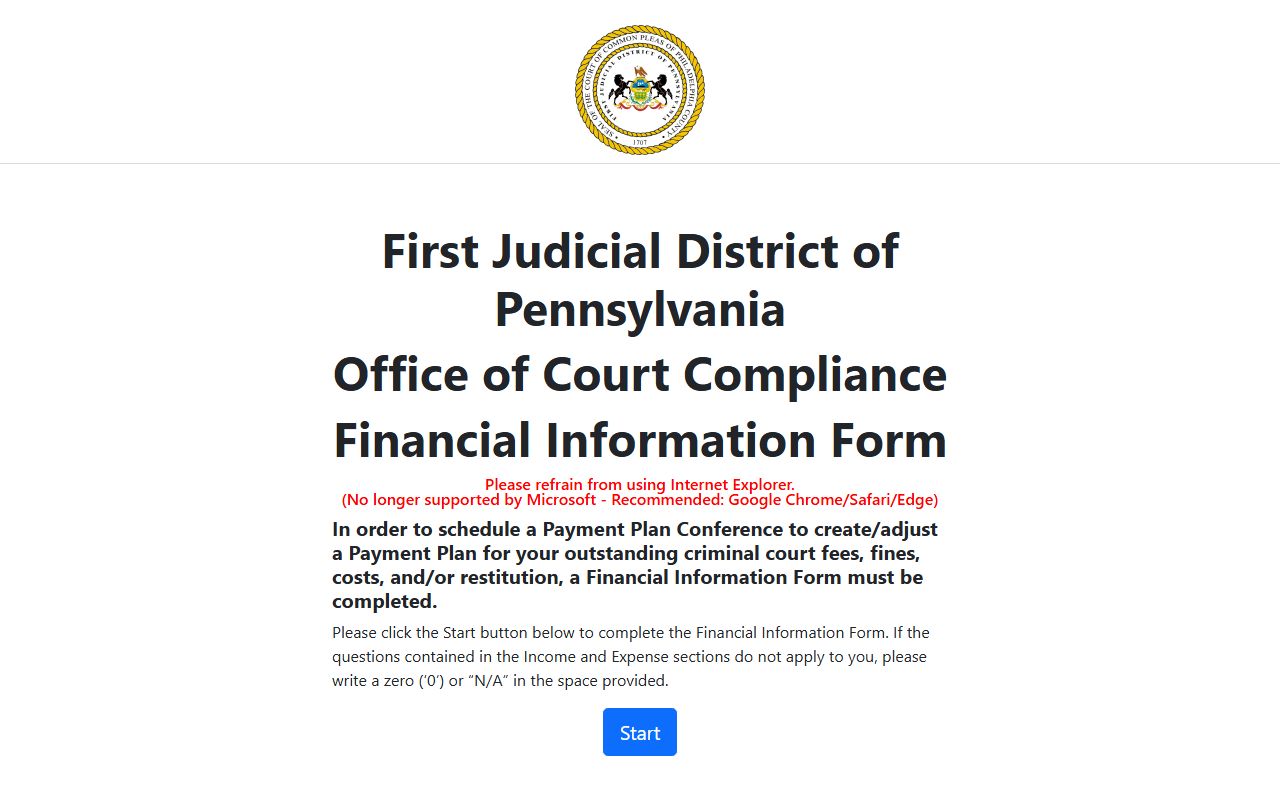
It is the official route for arranging a payment plan on court financial obligations.
Which Office Holds Which Record
Because Philadelphia splits its records duties, a quick reference saves a lot of confusion. The table maps common record types to the office that holds them, so you can aim your request at the right place from the start.
| Record You Want | Where to Go |
|---|---|
| Civil or criminal court dockets | Office of Judicial Records and the UJS portal |
| Marriage records and licenses | Register of Wills |
| Probate and estate records | Register of Wills and Orphans' Court |
| Jail custody location | Department of Prisons inmate locator |
| Warrants | Court docket, the Sheriff, or counsel |
| Federal cases | PACER for the Eastern District |
Office of Judicial Records Contact
The office operates out of City Hall as part of the First Judicial District. General court offices keep weekday hours, and the main phone line routes to the right department. Bring a case number and photo ID when you visit, and a way to pay copy fees. Because criminal matters are heard at the Stout Center on Filbert Street and traffic matters at Spring Garden Street, the building you need can depend on the case, so confirm the location for your record type before you travel. A quick call to the main line can save a trip to the wrong office.
Office of Judicial Records
City Hall, Broad & Market Sts.
Philadelphia, PA 19107
215-686-7000
Mon-Fri, 9 a.m. to 5 p.m.
What the Records Office Cannot Do
A clerk's office can explain forms, fees, filing locations, and procedural steps. It cannot give legal advice. Staff cannot tell you whether to file a case, how to argue a motion, or how a judge may rule. For legal help, the Defender Association covers criminal matters for eligible people, and civil legal aid groups such as Community Legal Services, Philadelphia Legal Assistance, and Philadelphia VIP help low-income residents with civil matters, while the SeniorLAW Center serves older adults.
The office also accepts passport filings, which is a service many people do not expect from a court records office. That mix of duties, from court filings to certified copies to passports, is a reminder that the Office of Judicial Records is a working counter for many First Judicial District functions, not only a place to read old cases. When you arrive, knowing exactly which service you need helps staff point you to the right window.
For the records themselves, see Philadelphia County court records and court dockets. For marriage and probate, see the Register of Wills. For the trial court structure, see the Court of Common Pleas page.