
Philadelphia County Probate and the Orphans' Court
Probate is the court-supervised process of settling a deceased person's estate, and it splits between two related offices. The Register of Wills probates wills, which proves they are valid, and issues letters of administration when a Philadelphia resident dies without a will. The office keeps wills, estate inventories, and related documents, acts as the inheritance-tax filing agent, and maintains the Orphans' Court dockets. The Orphans' Court Division of the Court of Common Pleas steps in for contested matters, guardianships, accounts, and petitions that need a judge.
The name "Orphans' Court" trips people up. It does not mean a court only for orphaned children. The court protects the personal and property rights of people and entities that cannot manage their own affairs, which includes estates, trusts, and guardianships. Understanding that scope helps explain why a probate search and a guardianship search both land in the same place.
The division of labor matters for a records search. Routine probate, such as opening an estate and getting letters, is a Register of Wills task that does not need a judge. A dispute, a formal account, or a guardianship petition moves into the Orphans' Court Division for a judicial decision. So the same estate can start as a clerk filing and later become a court case, with records in both places. Knowing which stage you are in tells you whether to call the Register or look to the Orphans' Court docket.
What Probate Records Include
Probate files hold the documents that move an estate from death to distribution. They include the original will and any codicils, the petition for probate, letters testamentary or of administration, estate inventories, accounts, decrees, and orders. Guardianship filings for minors and incapacitated persons sit here too, along with trust matters assigned to the Orphans' Court and inheritance-tax-related records. The Register of Wills runs an attorney online system for estate practitioners, shown below.
The screenshot is the Register of Wills attorney online system.
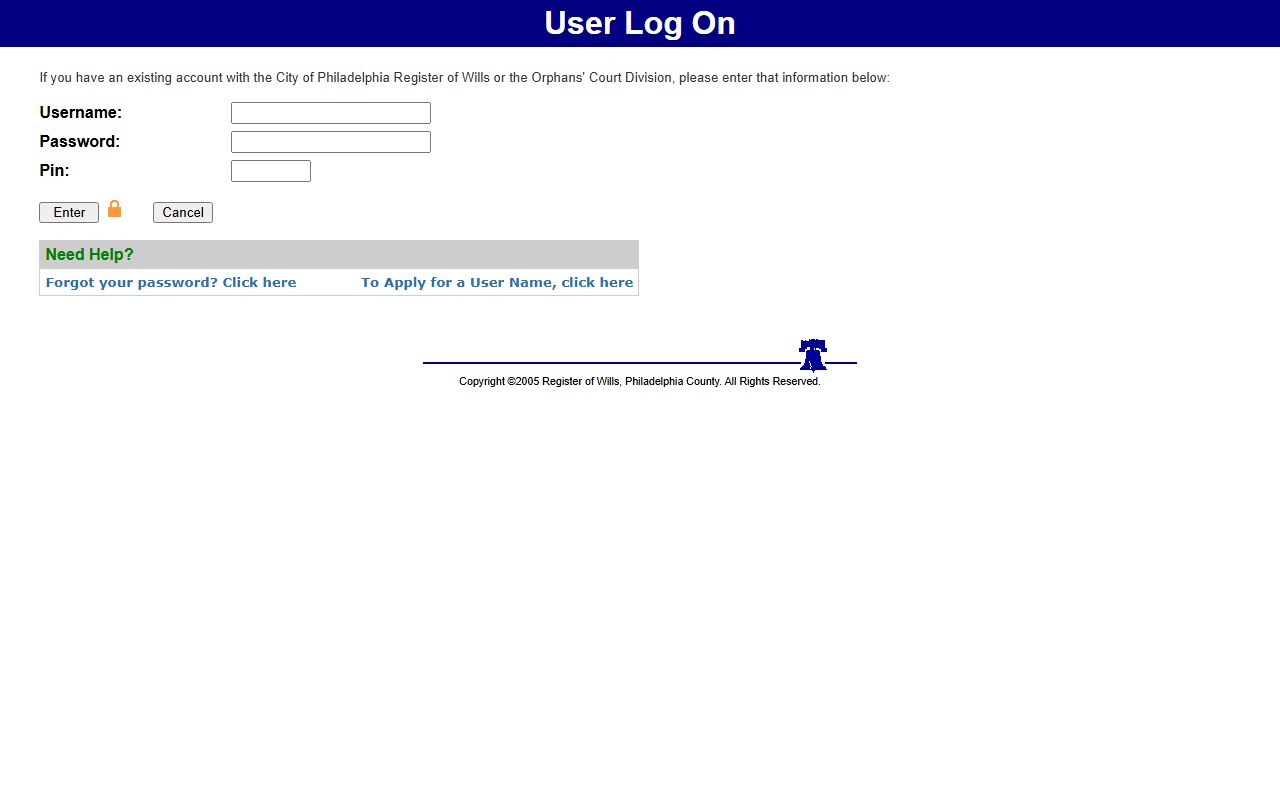
Attorneys use the login system, while members of the public use the service pages and request forms for estate records. The original will is an important record in its own right. Once a will is probated, it becomes part of the public estate file, which is how heirs and interested parties can confirm what a will says. Inventories and accounts later show what the estate held and how it was distributed, giving a full paper trail from the first filing to the close of the estate.
Common Probate Terms
Probate carries its own vocabulary, and a few terms come up again and again. The definitions below cover the words you are most likely to see in a Philadelphia estate file.
- Testator
- A person who makes a will.
- Executor
- The person a will names to settle the estate and carry out its terms.
- Administrator
- The person the Register appoints to settle an estate when there is no will.
- Intestate
- Dying without a valid will, which triggers administration rather than probate of a will.
- Guardian
- A person the Orphans' Court appoints to manage the affairs of a minor or an incapacitated adult.
How to Begin Probate With a Will
Probate starts at the Register of Wills, and the steps are clearer once you have the documents ready. The list below outlines the general path when there is a will.
- Confirm the decedent was a Philadelphia resident and locate the original will.
- Gather the death certificate, the will and any codicils, and the heirs and beneficiaries.
- Bring asset values, since the probate fee is based on the estate's value.
- File the required Register forms and pay the value-based probate fee.
- The Register issues letters if the requirements are met.
- The personal representative handles notice, inventory, debts, taxes, and distribution.
Contested matters, accounts, and petitions that need judicial action move into the Orphans' Court Division.
How Probate Works Without a Will
When a person dies without a will, the estate goes through administration rather than probate of a will. A petitioner asks the Register of Wills for letters of administration, which give someone the authority to manage the estate. The same documents matter: a death certificate, information on heirs, and asset values. Pennsylvania law sets who inherits when there is no will, so the administrator distributes the estate according to those rules rather than a written wish. These intestacy rules follow a set order among a surviving spouse, children, and other relatives.
The office can explain the forms, the fees, and the filing steps, but it cannot give legal advice. It cannot tell you who should serve as administrator or how to handle a dispute among heirs. For those questions, an estate attorney or legal aid is the right resource. The Register also acts as the inheritance-tax filing and payment agent, so settling an estate in Philadelphia ties the probate process to a tax obligation. A personal representative handles notice to heirs, an inventory of assets, payment of debts and taxes, and the final distribution, and the office can point to where each step is filed.
Philadelphia County Probate Fee Schedule
Probate fees rise with the value of the estate, and the schedule includes several components such as automation and record-management charges. The sample tiers below come from the official fee schedule. The schedule lists many more value ranges, and fees can change, so confirm the current amount before you file.
| Probate Value | Total Probate Fee |
|---|---|
| $0 to $250 | $189.25 |
| $250.01 to $1,000 | $210.25 |
| $1,000.01 to $2,000 | $224.25 |
| $10,000.01 to $50,000 | $385.25 |
| $50,000.01 to $200,000 | $490.25 |
| First $1,000,000 | $1,330.25 |
Copies of Orphans' Court records carry a separate per-page fee of $3 under 42 Pa.C.S. § 1725(c)(1)(ii). The total probate fee bundles several components, including automation, inventory, pleadings, judicial computer project, and record-management charges, which is why the figure is a single value-based number rather than a simple flat fee. For a large estate, the schedule continues past the first $1,000,000 with additional increments. Because the fee turns on the estate's value, having an accurate value ready when you file avoids a mismatch and a second trip to the counter.
Orphans' Court Docket Search
The First Judicial District links an Orphans' Court docket search from its case hub. A docket search can show the estate or party name, the filing date, the case type, party and counsel names, and docket entries. The table lists the main fields, with a reminder that remote access is limited.
| Field Label | Type | Required | Notes / Format |
|---|---|---|---|
| Case number / O.C. number | Text | Conditional | Best search for a known estate or guardianship case |
| Party / estate name | Text | No | Name search may be available |
| Case type | Dropdown | No | Estate, guardianship, trust, or other matter |
| Search | Button | n/a | Runs the docket query |
Under 204 Pa. Code § 213.81, probate and estate case records are generally limited online to dockets, orders, and opinions, so full file copies usually require a request to the office.
Probate Office Contacts
Two offices share the probate work, so the contact you need depends on the task. The Register of Wills handles probate filings and estate records, while the Orphans' Court Division handles judicial matters. Their details follow.
Register of Wills
City Hall, Room 180
Philadelphia, PA 19107
Probate: 215-686-6255
Mon-Fri, 8 a.m. to 4 p.m.
Orphans' Court Division
Court of Common Pleas, City Hall
Philadelphia, PA 19107
215-686-6255
Estates, guardianships, trusts
Guardianships and Incapacitated Persons
The Orphans' Court also protects people who cannot protect themselves, which is the heart of its name. Guardianship matters involve minors and incapacitated adults, and the court appoints a guardian to manage personal or financial affairs. These files can carry sensitive medical and financial information, so access may be more limited than a routine estate record. A guardianship case asks the court to decide that a person cannot manage their own affairs and to name someone to act for them, which is a serious step. The records document the petition, the court's decision, and the guardian's later accounts. Because the subject is a vulnerable person, the court balances public access against privacy more tightly than it does for an ordinary estate. For the court structure behind the division, see the Court of Common Pleas page, and for the office that keeps the records, see the Register of Wills.
For marriage records held by the same Register of Wills office, see marriage and divorce records. For civil and criminal court filings handled by a separate office, see the Office of Judicial Records.