
How to Find Philadelphia County Arrest Records
Start with the question of timing. If the person is in custody right now, use the city's incarcerated person locator, which searches the Philadelphia Department of Prisons with a name and date of birth or a PID. If you want the case that grew out of an arrest, use the statewide UJS Web Portal for the criminal docket sheet. The Municipal Court Criminal Division processes all arrests in Philadelphia County, holds preliminary arraignments around the clock, and handles summary and misdemeanor trials plus felony preliminary hearings.
There is no single Philadelphia "arrest blotter" with mugshots on the official sites reviewed. Instead, the public path is the criminal docket. A docket shows the charges, the arrest date, the offense tracking number, bail action, and the outcome. The booking and custody side lives with the Department of Prisons, while the charging and court side lives with the First Judicial District. Knowing this split is the key to a fast search. If your question is "where is this person being held," the inmate locator answers it. If your question is "what are the charges and what happened," the criminal docket answers that. Many people waste time looking for charges on the jail locator, which only returns a facility, or looking for a current cell location on a docket, which only tracks the case.
- Check the city inmate locator if the person may be in custody now.
- Open the UJS Web Portal and search criminal dockets by participant name.
- Add a first name and select Philadelphia to narrow the results.
- Open the docket sheet to read the charges, bail, and disposition.
Arrest Record vs Criminal Court Record
People use these terms as if they mean the same thing. They do not. An arrest record is the booking event and the custody trail. A criminal court record is the case that a prosecutor and a court build after the arrest. One arrest can lead to a Municipal Court docket and a later Common Pleas docket. The table sorts out the difference.
| Point | Arrest Record | Criminal Court Record |
|---|---|---|
| What it captures | Booking, custody, and the initial charge | The full case from charging to disposition |
| Where it lives | Police and the Department of Prisons | Municipal Court and Common Pleas dockets |
| How to search | City inmate locator | UJS criminal docket sheets |
| What it proves | That an arrest happened | The outcome, including any conviction |
For the full case history, use Philadelphia County court records; this page focuses on the arrest and custody side.
Charges vs Convictions in Philadelphia County
An arrest and a charge are accusations, not proof of guilt. A conviction is a guilty plea or a guilty verdict. This matters for fairness and for the law, because many records show charges that were later withdrawn, dismissed, or resolved through a diversion program. Reading a docket carefully prevents a wrong conclusion about someone's history. It also matters for jobs and housing, where a charge is sometimes treated as if it were a conviction. The docket is the place to see what really happened, because it lists the disposition for each count, not just the original arrest.
| Term | What It Means |
|---|---|
| Charge | The offense police or the prosecutor allege |
| Disposition | The result: guilty, not guilty, dismissed, or withdrawn |
| Conviction | A guilty plea or a guilty verdict |
| Nolle prosequi | The prosecutor dropped the charge |
Mugshots and Booking Information
The official Philadelphia inmate locator reviewed for this page does not publish a full booking profile with a mugshot, charges, bond, or pod assignment. It returns the facility where a person is held and points users to phone lines for anything more. That is a real limit, and it is different from counties that post a full jail roster with photos. Treat any mugshot site you find online with caution, because those are not official and are not part of the county record.
To confirm custody details, the Department of Prisons runs 24-hour inmate information lines at 215-685-8394, 215-685-8395, and 215-685-8396, with Spanish service at 215-685-8692. The Office of Community Justice and Outreach can help with other information at 215-685-7288, 215-685-7711, and 215-685-8909. For the facility list and contact methods, see Philadelphia County inmate records.
Booking, Arraignment, and Bail in Philadelphia
Philadelphia handles the front end of a criminal case in a way that is worth understanding before you read a record. After an arrest, the Municipal Court Criminal Division processes the case. The preliminary arraignment courtroom at the Stout Center, 1301 Filbert Street, runs 24 hours a day, every day of the year, so an arrest at any hour reaches a first hearing quickly. At that arraignment, charges are read and bail is addressed. A judge may set monetary bail, release on conditions, or deny bail.
From there, the Department of Prisons receives the person, classifies housing, and provides medical and behavioral screening. Bail can be paid through PAePay Bail, the official system maintained by the Unified Judicial System. The docket records each of these steps, so a careful read shows the arrest date, the arraignment, the bail action, and whether the person was held or released. A detainer entry means another case or a probation issue keeps the person in custody even if bail on the current charge is met.
What Arrest Records Are Public or Restricted
Adult criminal dockets are largely public through the UJS portal, but the policy still protects certain data. Court records redact Social Security numbers, driver's license numbers, SID numbers, victim contact information, and juror or witness details. Juvenile records are a separate world. Pennsylvania law treats juvenile proceedings and records as not open to the public, including summary juvenile matters in Municipal Court or Common Pleas. Access there usually needs party status, a statutory right, or a court order.
Statewide criminal-history dissemination is also governed by law. An arrest with no conviction does not give the public an open-ended right to every detail, and certain warrant and investigation materials can be sealed. The safest reading of a docket is to focus on the dated entries and the final disposition. Records that reveal a minor victim's name are sealed under Pennsylvania law unless a waiver applies. Mental health records tied to treatment are confidential. These limits exist to protect victims, minors, and people whose cases never led to a conviction, not to hide ordinary case outcomes from the public.
Sealed vs Expunged Records
Pennsylvania offers more than one way to limit a criminal record, and the words are not interchangeable. Expungement removes eligible records. Limited access, sometimes called sealing, hides eligible records from the general public while leaving them available to courts and law enforcement. Not every case qualifies for either path. The table sets out the difference, and the official rules follow below.
| Point | Sealed / Limited Access | Expunged |
|---|---|---|
| Effect | Hidden from public view | Removed from the record |
| Still visible to | Courts and law enforcement | Generally no one, once granted |
| Typical use | Some convictions after a waiting period | Nonconvictions, pardons, set cases |
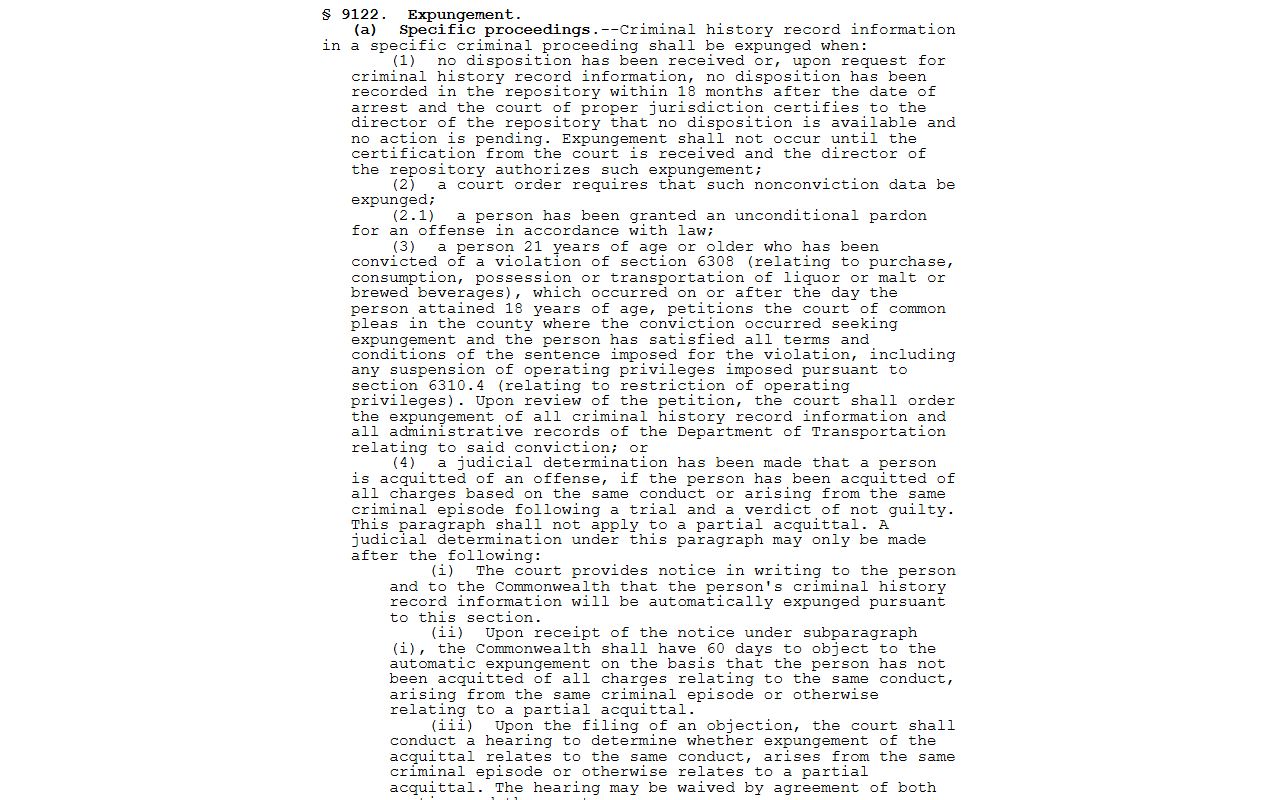
The main expungement statute is shown below.
The screenshot is 18 Pa.C.S. § 9122, which sets when criminal history records may be expunged.
The petition procedure for court cases sits in a separate rule, shown next.
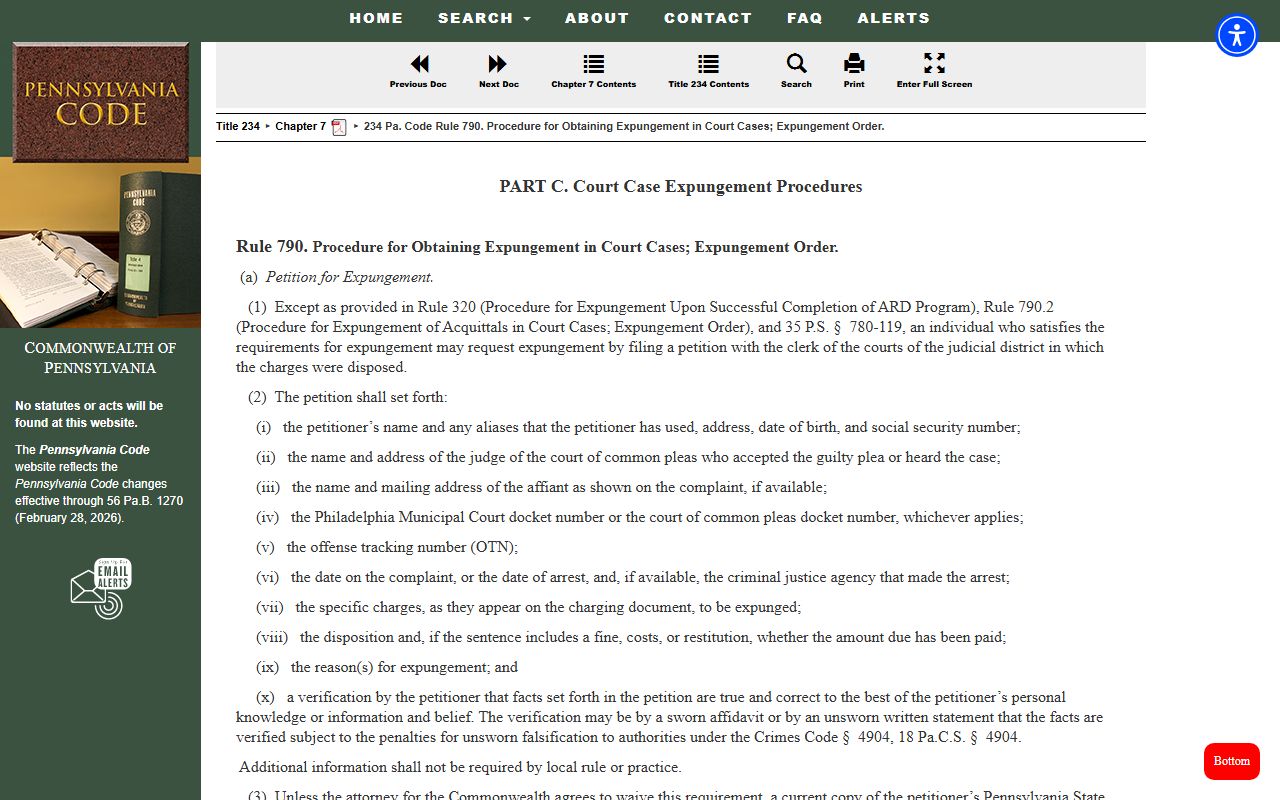
Under Pa.R.Crim.P. 790, an eligible person files a petition with the clerk in the district where the charges were disposed. The statute allows expungement in set situations, such as a case with no disposition recorded within 18 months after arrest with court certification, a court order to expunge nonconviction data, an unconditional pardon, or certain underage alcohol convictions once conditions are met. Successful completion of a diversion program like ARD can also open a path to expungement. Common reasons a petition is denied include an ineligible conviction, unpaid court costs, the wrong venue, or seeking expungement where only limited access is available. Legal aid groups such as Community Legal Services and the Defender Association can help check eligibility before you file.
The District Attorney and Defender Association
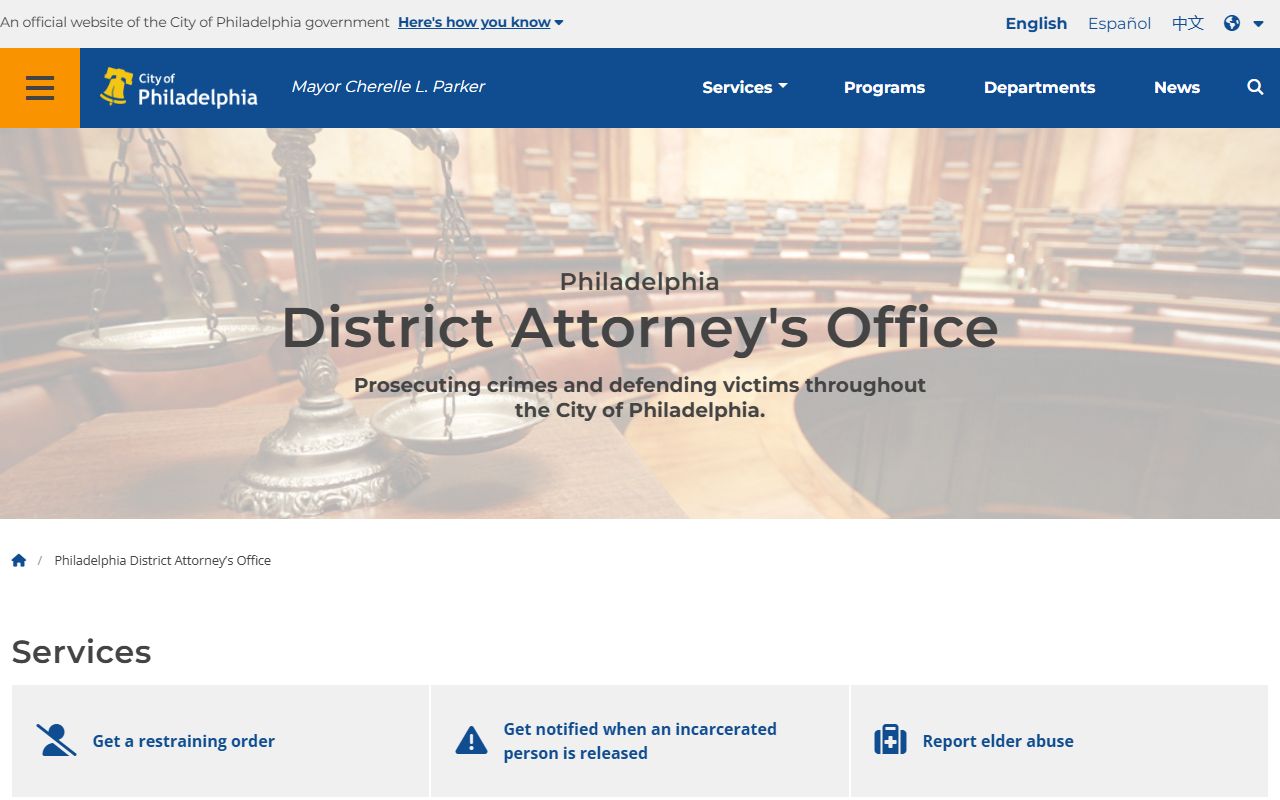
The Philadelphia District Attorney's Office prosecutes criminal cases in the county. It is the largest prosecutor's office in Pennsylvania, serving more than 1.5 million residents. The city page reports the office employs about 600 people, including roughly 300 assistant district attorneys, and prosecutes about 40,000 criminal cases each year. Larry Krasner is the District Attorney. The office is organized into divisions such as Trials, Investigations, Juvenile, Pretrial, and a Conviction Integrity Unit. The city DA page is shown below.
The DAO divisions and units page lists the specialized teams behind those numbers. It appears here.
The Defender Association of Philadelphia, created in 1934, provides defense for people who cannot afford a lawyer. Because the state Public Defender Act does not apply to Philadelphia County, the Defender Association fills the public defender role, funded by the City. The DAO also runs diversion programs, shown next, that can route a case away from a standard conviction.
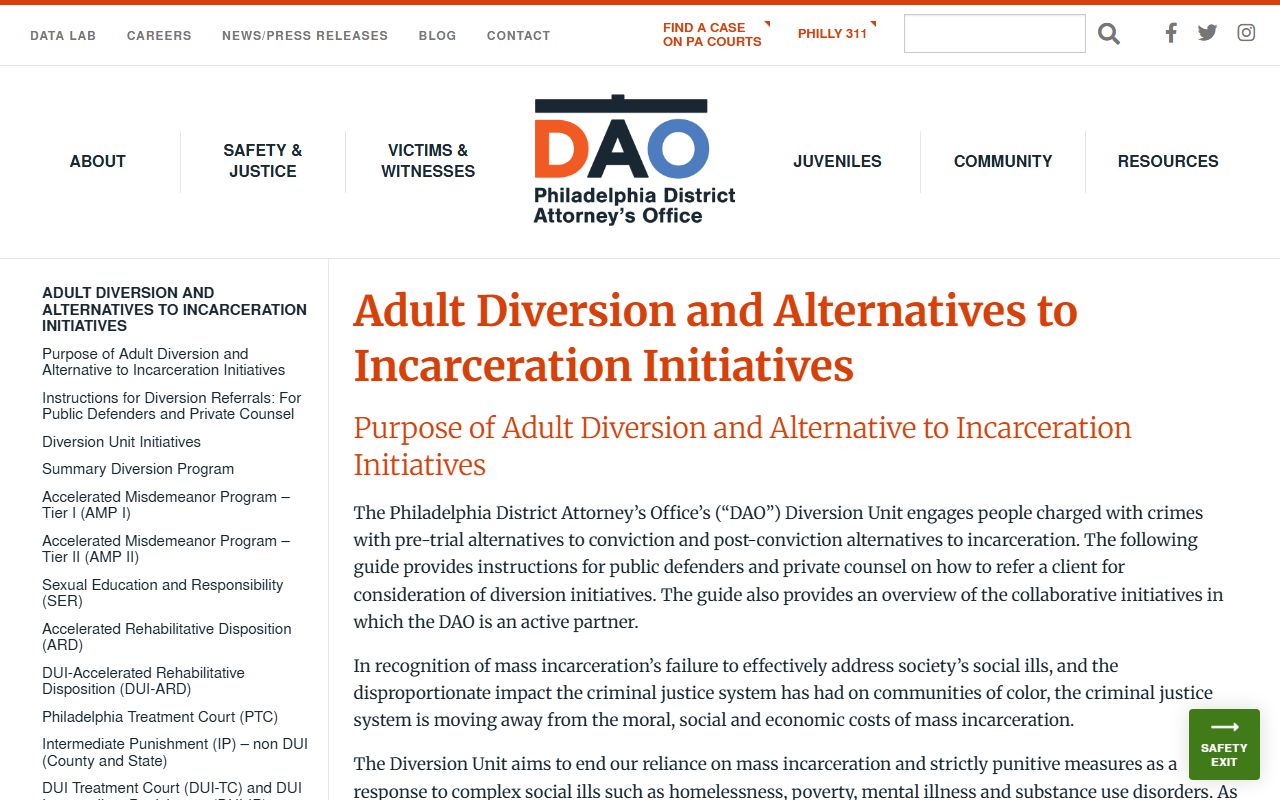
Programs like ARD, Veterans Court, and Summary Diversion can change how a case appears on a docket.
Federal Criminal Cases
Some Philadelphia arrests lead to federal charges rather than county charges. The U.S. Attorney's Office for the Eastern District of Pennsylvania prosecutes federal crimes in the region, and those cases are searched on PACER, not the county portals. The U.S. Attorney's Office page is shown below.
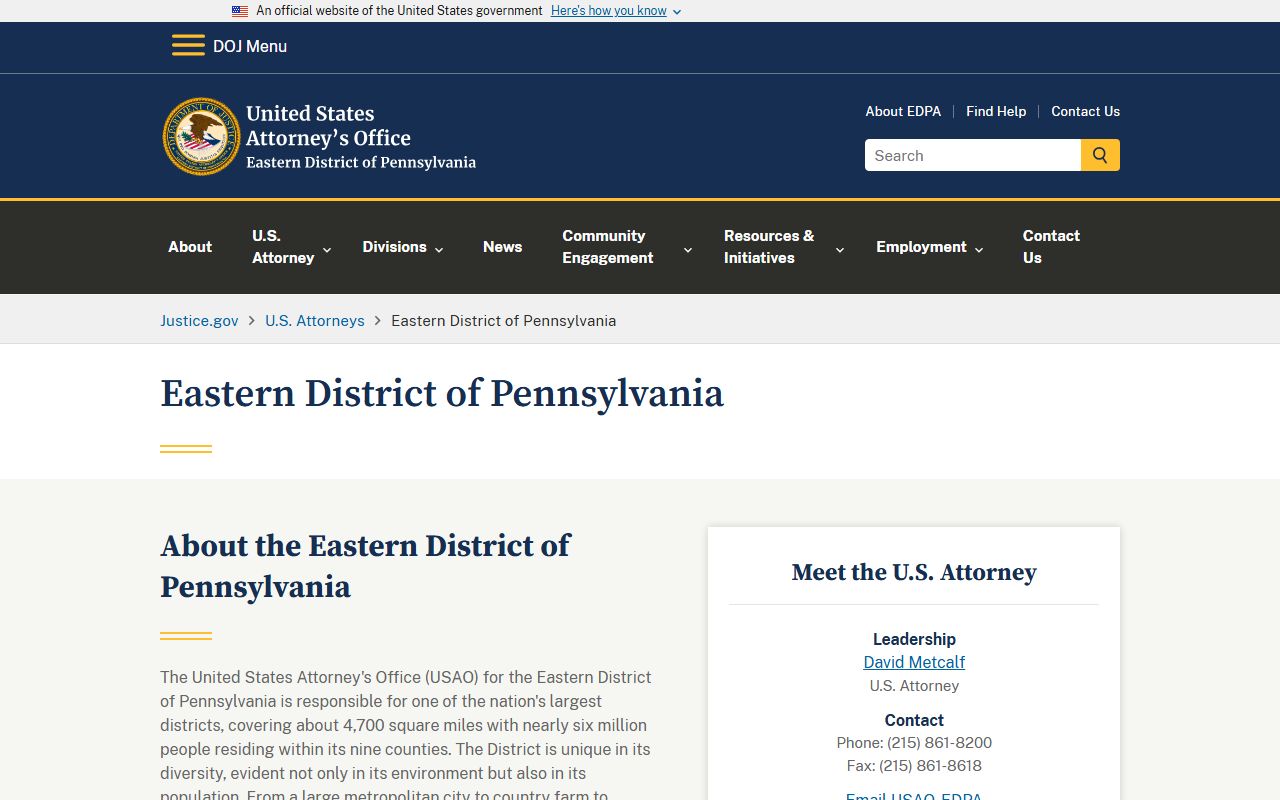
The office is led by a U.S. Attorney and supervises roughly 140 prosecutors across a nine-county district that includes Philadelphia. The U.S. Attorney biography page is shown below.
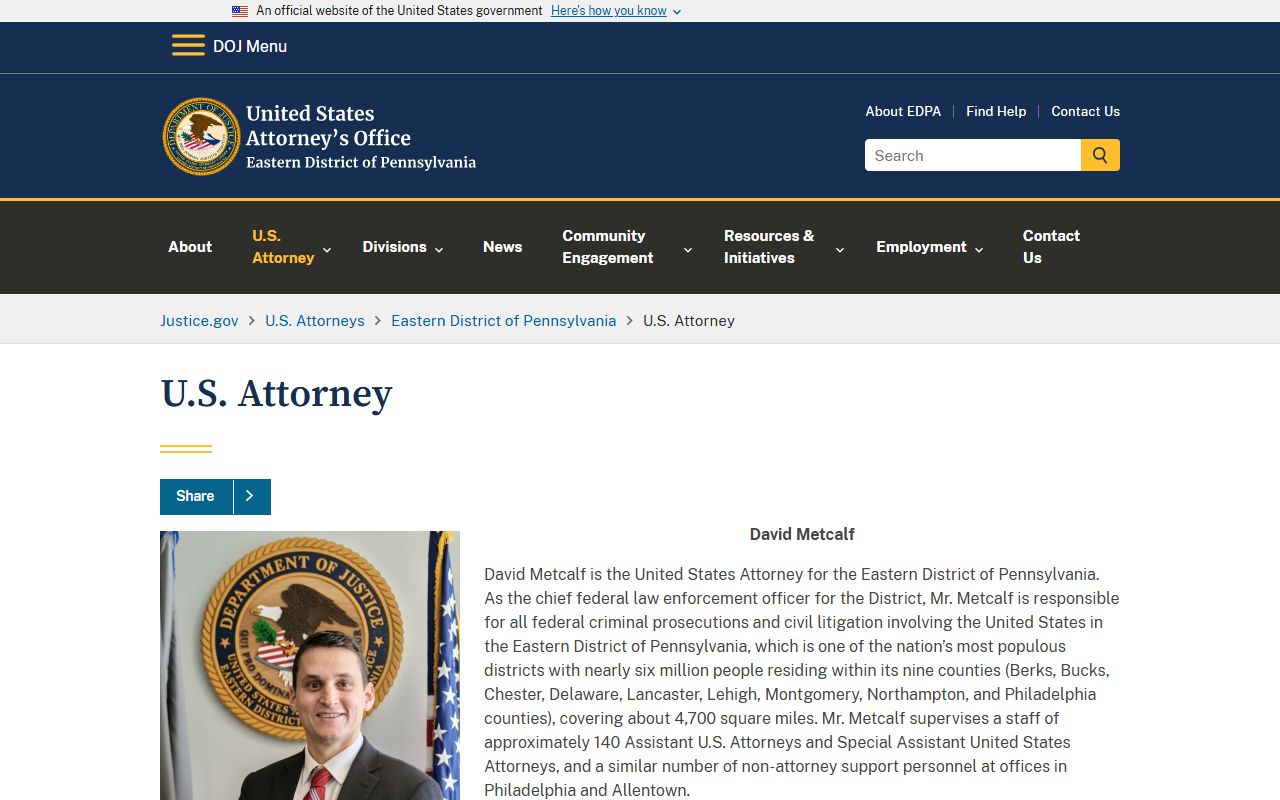
If the charging party is the United States, the case is federal; if it is the Commonwealth of Pennsylvania, it is a county case on the UJS portal.