
How to Check for Philadelphia County Warrants
The practical route is the court docket. Many warrants in Philadelphia are bench warrants, which a judge issues when a person misses a court date or violates a condition. A bench warrant often shows up as a docket entry on the UJS criminal docket sheet. So the first step is to find the case, then read the entries for a warrant action. Do not rely on unofficial warrant websites, which are not the county record and can be wrong.
If you think a warrant may exist, search by name and case, then verify with the court or a lawyer. The Defender Association or private counsel can check status without exposing you to a surprise arrest at a counter. This caution matters more in Philadelphia than in counties that post a clean public warrant list, because here the warrant usually surfaces inside a larger criminal case rather than on a standalone page. A lawyer can also tell you whether a warrant is the kind that needs a court appearance, a bail payment, or a surrender, which is information a raw docket entry may not spell out.
- Open the UJS Web Portal and search criminal dockets by name.
- Select Philadelphia and open the matching docket sheet.
- Read the docket entries for a bench warrant, bail revocation, or detainer.
- Confirm the status with the court or an attorney before you act.
Why There Is No Public Warrant List in Philadelphia
No official Philadelphia public active-warrant search portal with a direct searchable list was located in the sources reviewed. That is a real gap, and it shapes how a warrant search works here. The Sheriff's Office handles fugitive warrants through its Fugitive Warrant Unit, but the office describes that work as reducing a backlog, not as a public lookup tool. Court-issued bench warrants are visible through dockets instead.
The Philadelphia Sheriff's Office homepage is shown below.
The screenshot is the Philadelphia Sheriff's Office homepage.

Sheriff Rochelle Bilal leads the office, which also handles court security, prisoner transport, civil enforcement, and sheriff sales. The Sheriff's deputies protect witnesses, juries, judges, and the public across six court buildings and transport hundreds of prisoners to court appearances on a typical court day. The Fugitive Warrant Unit is the part of the office most tied to warrants, but its caseload is operational, not a search tool the public can query. So the absence of a public sheriff warrant list is by design, not an oversight.
Bench Warrants and Probation Detainers
Bench warrants are the most common warrants a Philadelphia resident will run into. A judge issues a bench warrant when a person fails to appear, misses a payment plan listing, or violates a condition of release. Because the warrant is tied to an existing case, it shows up as a docket entry rather than on a separate warrant page. That is why the docket search is the practical first step for most people who worry about a warrant.
Probation and parole detainers work like warrants even when they are not labeled that way. A detainer is a hold that keeps a person in custody because another case or a supervision issue requires it. Philadelphia's prison population reports track probation detainers and other holds as a major reason people remain in jail, which shows how often detainers, not just new charges, drive custody. If a docket shows a detainer, posting bail on the current charge may not lead to release until the detainer is resolved.
Types of Warrants in Philadelphia County
Not all warrants are the same, and the type changes how you find and resolve it. Some are court orders tied to an existing case. Others start a new criminal matter or authorize a search. The list below covers the main kinds you will see in Philadelphia County records.
- Arrest warrant: issued on a criminal complaint and probable cause.
- Bench warrant: issued by a judge, often after a missed court date or a probation violation.
- Search warrant: authorizes a search or seizure; unexecuted ones are not public.
- Fugitive warrant: requires the apprehension of a wanted person.
- Probation or parole detainer: a hold that works like a warrant to keep a person in custody.
The Sheriff's responsibilities page describes the Fugitive Warrant Unit and its work on serious cases. It is shown next.

The unit works to reduce a backlog of roughly 3,200 warrants, including charges as serious as murder, assault, domestic abuse, and child molestation. Each type below resolves a different way, so the first task in any warrant search is to learn which kind you are dealing with.
Philadelphia County Warrant Search Fields
Because warrant information surfaces through the criminal docket, the search fields are the docket fields. You search by name or docket number on the UJS portal, then look for a warrant entry. The table lists the fields you will use.
| Field Label | Type | Required | Notes / Format |
|---|---|---|---|
| Defendant last name | Text | Conditional | Use the UJS criminal docket participant search |
| First name | Text | No | Narrows the search |
| Docket number | Text | Conditional | Best if known |
| County | Dropdown | Conditional | Select Philadelphia |
| Warrant / docket entries | Output | n/a | Bench warrant or bail events appear in the entries |
What a Philadelphia County Warrant Record Shows
When a warrant appears in a docket, it comes with details that help you understand and resolve it. A warrant entry is not just a flag; it carries dates and a reason. The table lists the fields you may see in the docket entries.
| Field | What It Shows |
|---|---|
| Docket Number | The case the warrant belongs to |
| Defendant Name | The person named in the warrant |
| Issuing Court / Judge | Who ordered the warrant |
| Date Issued | When the warrant was entered |
| Reason | Failure to appear, probation detainer, bail revoked, or contempt |
| Bail Status | Whether bail is set, denied, or revoked |
| Resolution Date | When a warrant was lifted or quashed, if resolved |
Search Warrants and Public Access
Search warrants follow strict access rules that protect investigations and safety. Under Pennsylvania criminal procedure, an unexecuted search warrant has no public access until it is executed. A search warrant affidavit can be sealed for a time and unsealed later, sometimes with extensions. Arrest warrant information can also be delayed for good cause and sealed under rule. Grand jury materials and sealed indictments are not public while sealed.
Those rules are why a warrant search can come up empty even when a warrant exists. The smart move is to avoid guessing from an absent result and instead confirm directly with the court or counsel. The same logic applies to arrest warrants for new charges, which a court can keep from public view for a short period for good cause and seal for longer under rule. These protections balance public access against the need to keep an investigation or a person's safety intact, and they are a normal part of how Pennsylvania handles warrant information.
Important: Do not read "no online result" as "no warrant." Warrant information can be sealed or delayed, so verify status through the court or an attorney.
How to Resolve an Outstanding Warrant
If a bench warrant turns up, handle it through official channels. A warrant rarely clears on its own, and ignoring it can lead to an arrest. The steps below follow the official path for a Philadelphia case.
- Search the docket and confirm the warrant entry and the case it belongs to.
- Contact your attorney, the Defender Association, or private counsel.
- For a Municipal Court criminal matter, reach the Criminal Division at MCCriminal@courts.phila.gov or 215-686-7000.
- If bail is set and eligible, use PAePay Bail or the court's bail-acceptance instructions.
- Appear as directed; some warrants require surrender or a new arraignment.
- After it is resolved, check the docket again, since clearance may not post right away.
Bail is tied to the docket and current custody status, not to private bond ads. Some people are held without bail, with revoked bail, or with a detainer that a bail payment will not lift. The prison population reports back this up, since they classify many people by detainers and open cases rather than a single new charge. The practical lesson is to treat a warrant as part of a larger case picture. Clear the warrant through the court, then confirm whether any detainer or open case still affects custody before you assume the matter is finished.
Federal Warrants and the U.S. Marshals
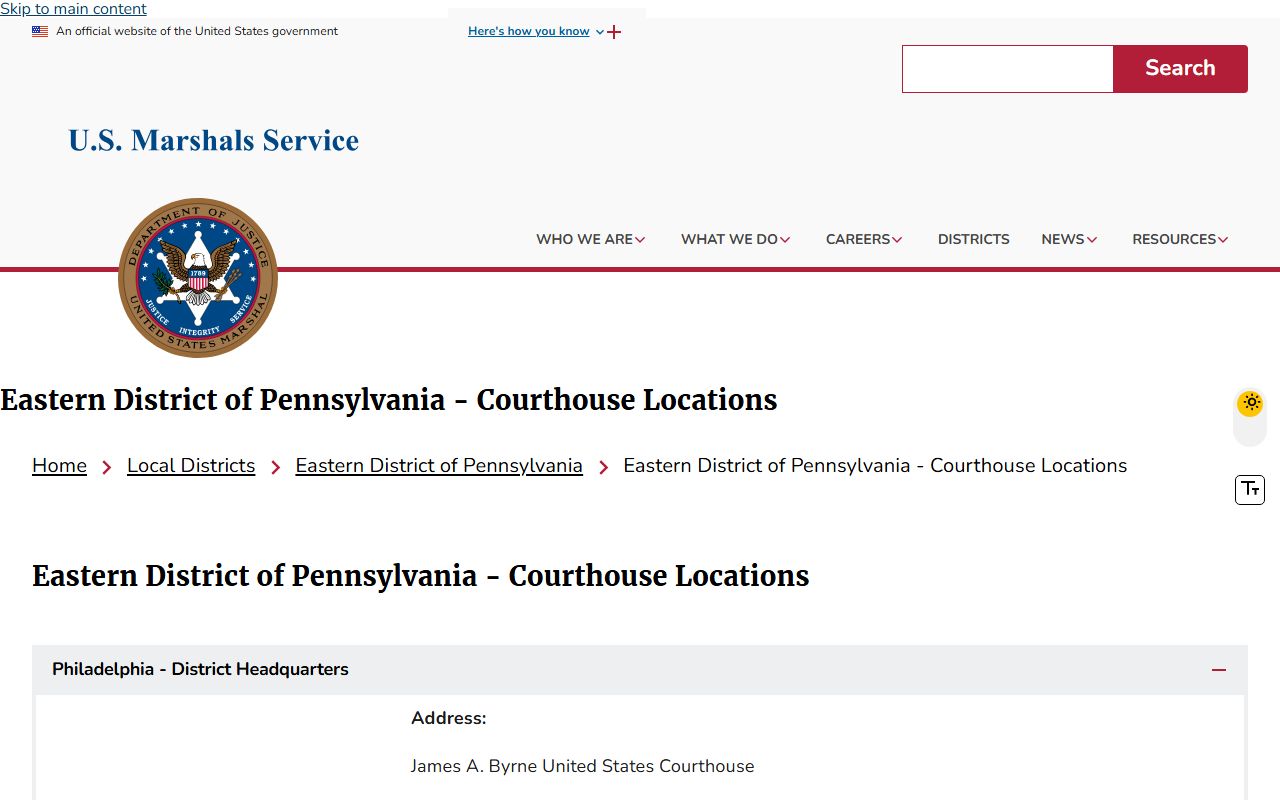
Federal warrants are separate from county and state warrants. The U.S. Marshals Service for the Eastern District of Pennsylvania handles federal warrants and fugitive work in the region, based at the Byrne U.S. Courthouse on Market Street. The Marshals courthouse page is shown below.
Federal cases and warrants are searched through PACER and the federal courts, not the First Judicial District systems. If a federal agency is involved, the warrant and any related case will not appear on the county docket at all, which is another reason an empty county search is not the full picture.