How to Search Philadelphia County Court Records
There is no single search box for the whole county. The best starting point is the First Judicial District "Calendars & Case Information" page. It splits calendar searches from case searches and links out to each docket system. Criminal cases run through the statewide Pennsylvania UJS Web Portal. Civil cases run through the Common Pleas Trial Division civil docket links. Small claims, landlord-tenant, and code matters sit in Municipal Court Civil. Estates and guardianships sit with Orphans' Court and the Register of Wills.
Before you start, pick the case type and gather what you know. A full name helps. A case or docket number helps more. Common Pleas criminal dockets often look like CP-51-CR-1234567-2024, and Municipal Court criminal dockets use MC-51 formats. Knowing the court saves time because each portal searches a different set of records.
Here is the official path the First Judicial District points users to when they look up a case online.
- Open the FJD hub at courts.phila.gov/casesearch and choose case information, not the calendar.
- Pick the court. Use the UJS Web Portal for criminal dockets, or the Common Pleas civil docket link for civil cases.
- Search by party name or docket number. For civil cases, the city service page allows case number, plaintiff, or defendant.
- Narrow by county. Choose Philadelphia so you do not pull cases from other judicial districts.
- Open the docket sheet and read the entries. The sheet is free; full pleadings may need a clerk request or an in-person visit.
The case hub keeps every docket link in one place, which is why it is the smart first stop. Take a look at the official page below.
The screenshot comes from the First Judicial District Calendars & Case Information hub.
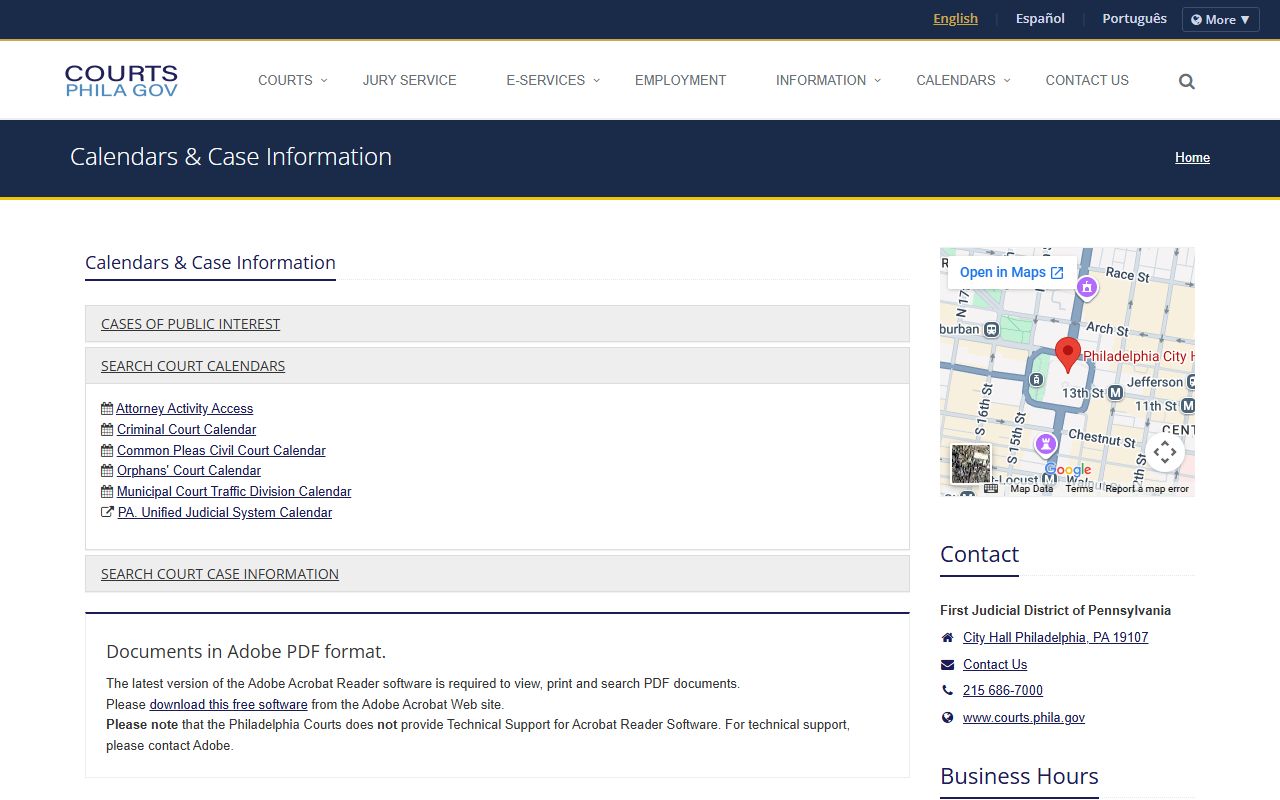
From this page you can reach civil, family, Orphans' Court, Municipal Court, traffic, and statewide criminal dockets without hunting across many sites.
The Philadelphia County Judicial System
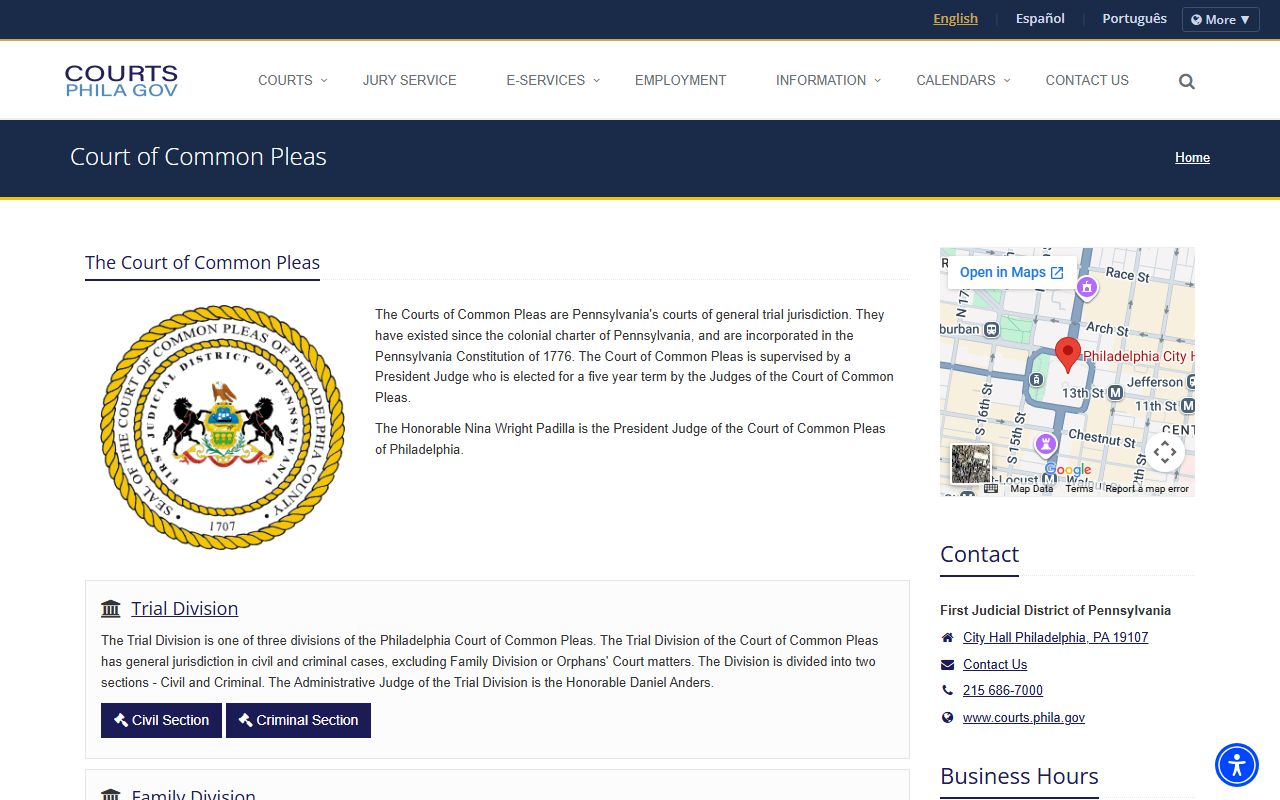
Philadelphia County is the same as the First Judicial District. That is a key fact for searching court records here. Pennsylvania calls its main trial court the Court of Common Pleas, not a "district court." The Common Pleas court has three divisions: Trial, Family, and Orphans' Court. The Trial Division handles civil and criminal sections. The Family Division at 1501 Arch Street handles divorce, custody, support, and juvenile matters. The Orphans' Court Division handles estates, trusts, and guardianships.
Below the Court of Common Pleas sits the Philadelphia Municipal Court. Most counties in Pennsylvania use magisterial district judges for small cases. Philadelphia is different. It uses the Municipal Court for small claims, landlord-tenant cases, code enforcement, traffic, and the first steps of criminal cases. The Court of Common Pleas page notes that the President Judge is elected by the judges of the court; the Honorable Nina Wright Padilla holds that role as of the official page reviewed.
Case flow: Philadelphia Municipal Court › Court of Common Pleas › Superior Court or Commonwealth Court › Supreme Court of Pennsylvania
| Court | Jurisdiction | Case Types |
|---|---|---|
| Philadelphia Municipal Court | Lower court of the First Judicial District | Small claims to $12,000, landlord-tenant, code to $15,000, traffic, summary and misdemeanor trials, felony preliminary hearings |
| Court of Common Pleas | General trial court | Felony trials, larger civil suits, family, estates, appeals from Municipal Court |
| Superior Court of Pennsylvania | Intermediate appeals | Most civil and criminal appeals from common pleas |
| Commonwealth Court | Intermediate appeals | Government, agency, and public-sector matters |
| Supreme Court of Pennsylvania | Highest court | Discretionary review; oversees the Unified Judicial System |
The Court of Common Pleas overview page explains the general trial role and the three divisions. The image below shows that official page.
For lower-court matters, the Municipal Court page lists each division and its contacts. That page is shown next.
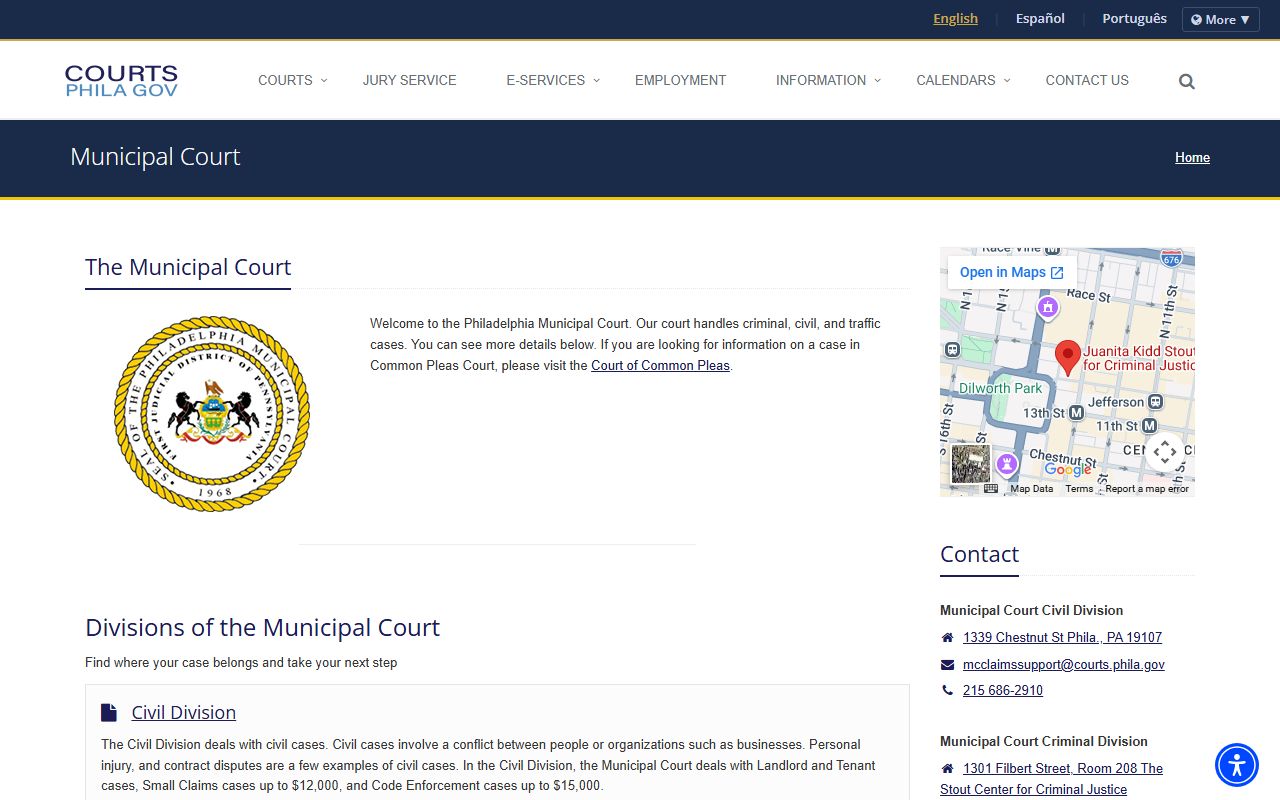
Many felony cases start in Municipal Court and then move to Common Pleas, so one arrest can show up on two dockets.
| Feature | Court of Common Pleas | Municipal Court |
|---|---|---|
| Role | General trial court | Lower court for local matters |
| Civil limit | Larger civil claims and appeals | Small claims up to $12,000 |
| Criminal role | Felony trials and sentencing | Processes arrests; holds preliminary hearings |
| Main building | City Hall and the Stout Center | 1339 Chestnut St. and 1301 Filbert St. |
Philadelphia County Courthouses
Philadelphia does not have one county courthouse. Court work is spread across several Center City buildings. City Hall, at Broad and Market Streets, is the symbolic court address and the home of the Register of Wills in Room 180. The Justice Juanita Kidd Stout Center for Criminal Justice at 1301 Filbert Street is the main criminal building. Family Court sits at 1501 Arch Street. Municipal Court Civil is at 1339 Chestnut Street. The Traffic Division is across town at 800 Spring Garden Street with longer weekday hours.
The First Judicial District homepage is the front door to all of these offices, with news, e-services, and language-rights notices. That homepage is shown here.
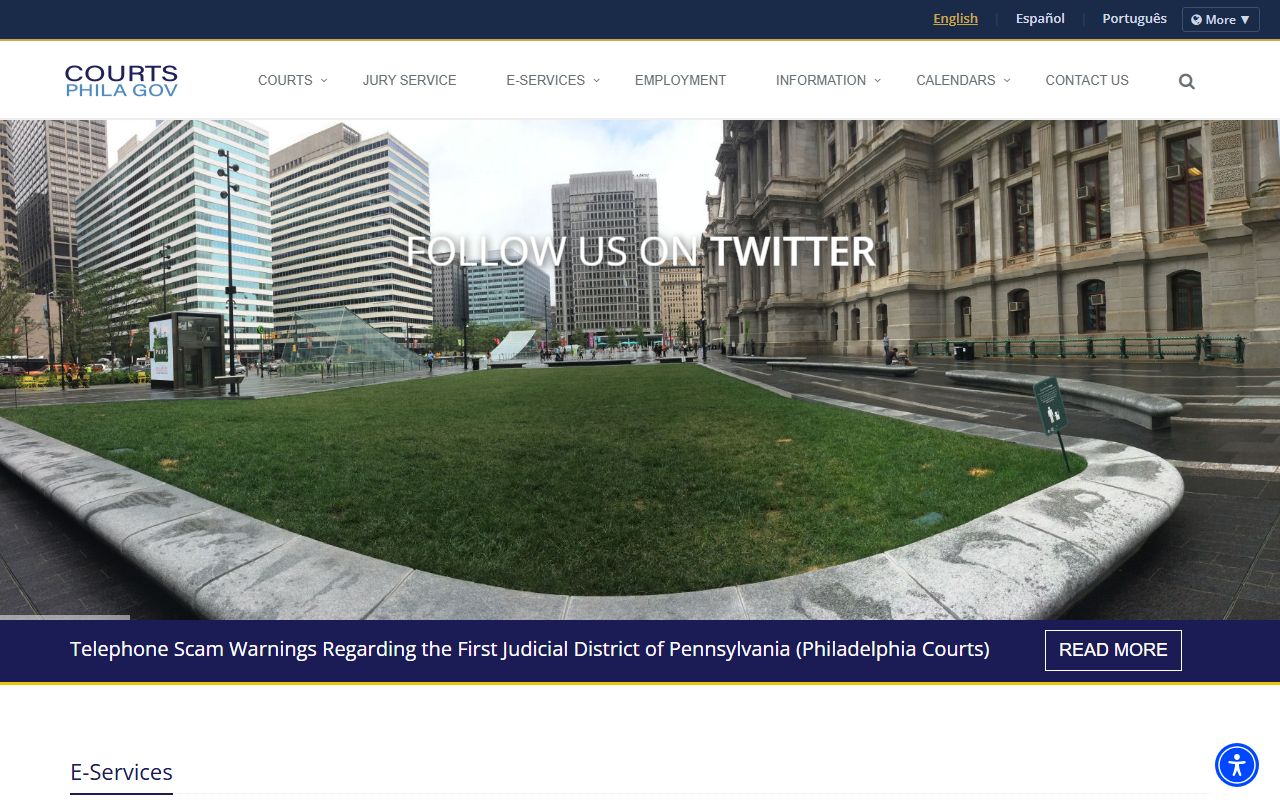
Hours and addresses change by building, so check the official court locations and hours page before you go. It is shown below.
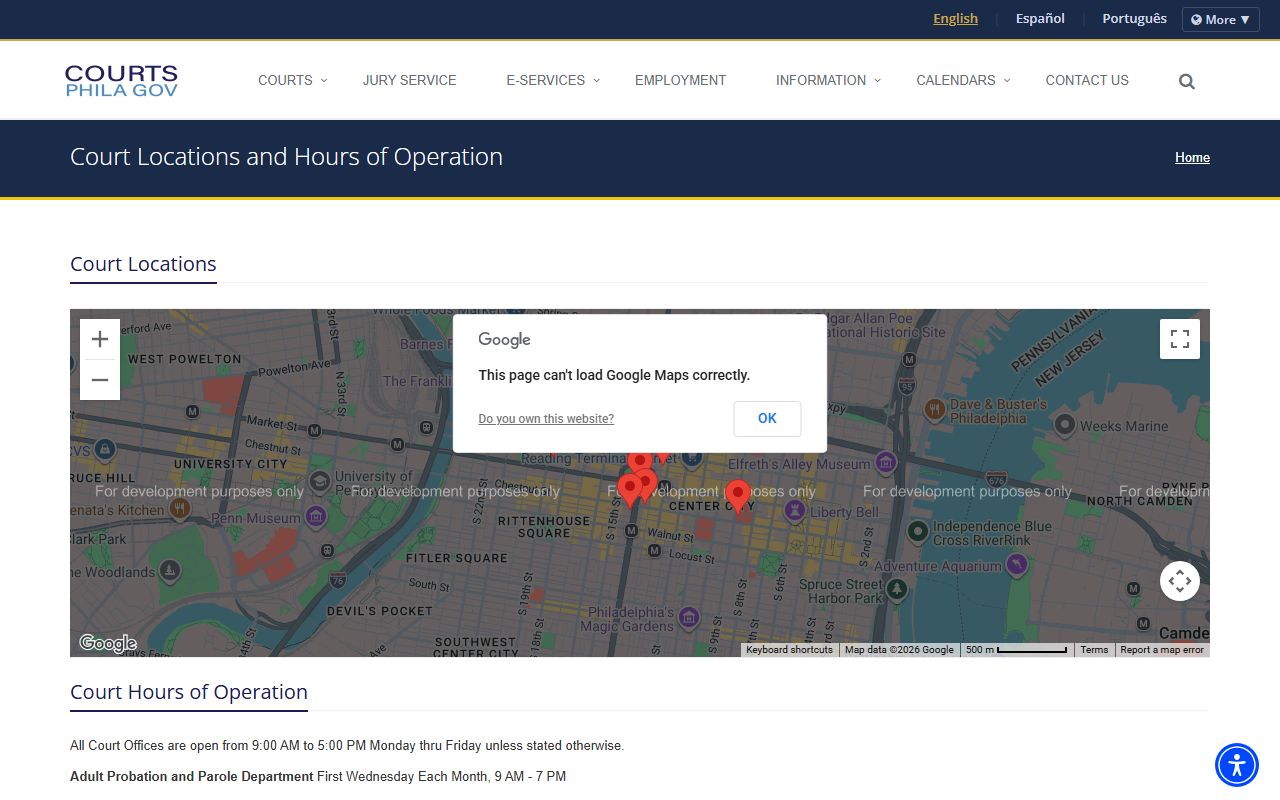
First Judicial District / City Hall
City Hall, Broad & Market Sts.
Philadelphia, PA 19107
215-686-7000
Mon-Fri, 9 a.m. to 5 p.m.
Stout Center for Criminal Justice
1301 Filbert St., Room 208
Philadelphia, PA 19107
215-686-7000
Arraignment open 24/7
Municipal Court Traffic Division
800 Spring Garden St.
Philadelphia, PA 19123
215-686-1676
Mon-Fri, 8:30 a.m. to 6:30 p.m.
For a full directory of office numbers and emails, the FJD contact page is the official source, shown below.
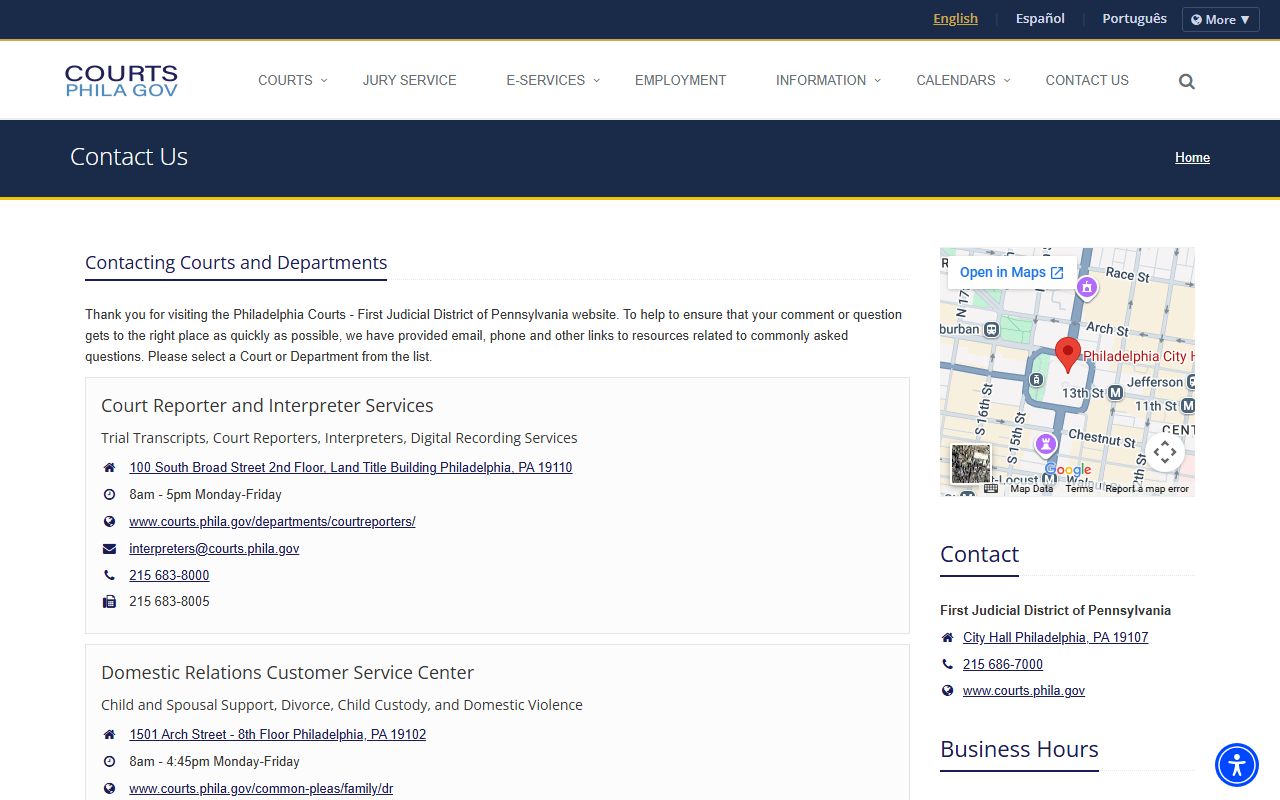
Pick the building that matches your case so you are not sent across the city to a different office.
Types of Court Records Available in Philadelphia County
Philadelphia County court records cover a wide range of case types. Civil records include complaints, motions, orders, judgments, and docket entries. Criminal records include charges, bail events, pleas, verdicts, and sentences. Family records cover divorce, custody, support, and protection from abuse, though remote access is limited. Probate records sit with the Register of Wills and Orphans' Court. Traffic records cover city vehicle-law citations, but not parking, red-light camera tickets, or DUI.
Which court holds the file depends on the matter. The Common Pleas Trial Division handles civil and felony criminal cases. The Municipal Court handles small claims, landlord-tenant, code, and most arrest processing. The Family Division handles domestic relations. The Register of Wills handles estates and marriage records.
- Criminal records - charges, bail, dispositions, and sentences from Philadelphia court records on the UJS portal.
- Civil records - complaints, judgments, and debt collection dockets through FJD civil access.
- Family and divorce records - divorce, custody, and support with limited remote access; see marriage and divorce records.
- Probate records - wills, estates, and guardianships through the Orphans' Court and Register of Wills.
- Traffic records - citations, hearings, and fines from the Municipal Court Traffic Division.
What Philadelphia County Court Records Show
A docket sheet is the public skeleton of a case. It lists the case number, the court, the parties, and a dated log of filings and events. For criminal cases it shows charges, bail action, pleas, and the final disposition. For civil cases it shows the claim, motions, and any judgment. The underlying documents, like full pleadings or transcripts, are often not posted online. Court policy also redacts personal identifiers such as Social Security numbers, driver's license numbers, and victim contact information.
| Field | What It Shows |
|---|---|
| Case Number | The court's unique ID, like CP-51-CR for Common Pleas criminal cases |
| Filing Date | When the case or docket opened |
| Parties | Plaintiff and defendant, or Commonwealth v. defendant in criminal cases |
| Charges / Cause | The statute, offense grade, and counts, or the civil claim |
| Disposition | The outcome: guilty, not guilty, dismissed, withdrawn, or settled |
| Sentence / Judgment | The penalty or money award, plus fines, costs, or restitution |
Online dockets are reliable for the procedural story of a case. They are not a stand-in for the full courthouse file.
Public Access Laws for Philadelphia County Court Records
Court case records in Pennsylvania follow the Unified Judicial System's Case Records Public Access Policy, not just the open-records law. The policy says case records are open unless a law or rule restricts them. It also limits remote access and protects confidential information. City and county agency records, by contrast, fall under the Pennsylvania Right-to-Know Law, which the City applies through its own open-records policy.
Key Statutes:
204 Pa. Code § 213.81 - the statewide policy that makes court case records public, sets request steps, and limits remote access.
18 Pa.C.S. § 9122 - sets when criminal history records can be expunged.
65 P.S. §§ 67.101 et seq. - the Right-to-Know Law for City and agency records, with appeals through the Office of Open Records.
One rule worth knowing: under the case-records policy a person can often make an oral request to the right custodian for a simple record. Viewing a file stored at the courthouse should not carry a fee, though copy fees can apply.
Records That Are Restricted or Confidential
Not every record is open. Juvenile records are heavily restricted under Title 42 and court policy. Adoption and mental health records are confidential. Family court files limit remote access to dockets, orders, and opinions, while income statements, property inventories, and medical records stay protected. Sealed search warrant affidavits, grand jury materials, and unexecuted warrants are not public.
To view a sealed record, a person usually needs party status, a statutory right, or a court order. For expungement, the main path runs through 18 Pa.C.S. § 9122 and the petition procedure in Pa.R.Crim.P. 790. Not all convictions qualify, and "limited access" is different from a full expungement.
Specialty Courts in Philadelphia County
Philadelphia leans hard on diversion and treatment courts. The District Attorney's Office and the First Judicial District both run programs that move eligible people out of the standard trial track. Accelerated Rehabilitative Disposition, or ARD, is a pretrial program for some first-time defendants; finishing it can open a path to expungement. Veterans Court serves eligible veterans whose conduct ties to service-related needs, and oversight will not run longer than a normal sentence.
Other tracks include State Intermediate Punishment as a structured alternative to a state prison term, Summary Diversion for low-level cases, and a Residential Mortgage Foreclosure Diversion Program that helps homeowners and lenders reach a resolution before a foreclosure moves ahead. These programs change a case's docket path, so a record may show a diversion listing instead of a standard trial date.
Philadelphia County Sheriff and Jail
Philadelphia splits jail and sheriff duties in a way that surprises many people. The Philadelphia Department of Prisons runs the local jails, not the sheriff. The Philadelphia Sheriff's Office, led by Sheriff Rochelle Bilal, handles court security, prisoner transport, civil enforcement, sheriff sales, and a Fugitive Warrant Unit. The Department of Prisons operates four facilities on State Road in Northeast Philadelphia: Curran-Fromhold, the Detention Center, the Industrial Correctional Center, and Riverside.
To find someone in custody, use the city inmate locator with a name and date of birth or a PID. For the full roster details, contact methods, and visiting rules, see Philadelphia County inmate records, and check warrant records for how bench warrants show up on a docket.
Marriage, Divorce, and Orphans' Court
Marriage licenses and marriage records run through the Philadelphia Register of Wills, which also serves as Clerk of the Orphans' Court. The office keeps marriage records dating back to 1915. Divorce is a Family Division matter at the Court of Common Pleas, with limited public access online. Estates, wills, and guardianships are Orphans' Court matters. For the full process, see marriage and divorce records and probate records.
- Testator
- A person who makes a will.
- Executor
- The person named in a will to settle the estate and carry out its terms.
- Guardian
- A person the Orphans' Court appoints to manage the affairs of a minor or an incapacitated adult; some states call this role a conservator.
Philadelphia County Court Records Fees
Fees depend on the office and the record. Viewing a case file at the courthouse should be free under the statewide policy, but copies and certified copies carry charges. The Register of Wills and Clerk of the Orphans' Court set value-based probate fees and a flat research fee for marriage record requests. The fees below come from official fee schedules and the public-access policy.
| Item | Amount |
|---|---|
| Orphans' Court copy, per page | $3 (42 Pa.C.S. § 1725(c)(1)(ii)) |
| Marriage record research fee | $15 money order |
| Probate fee, estate value $0 to $250 | $189.25 |
| Probate fee, first $1,000,000 of value | $1,330.25 |
| View case records at the courthouse | No charge under 204 Pa. Code § 213.81 |
The FJD publications page posts current forms, fee lists, and local rules. That page is shown below.
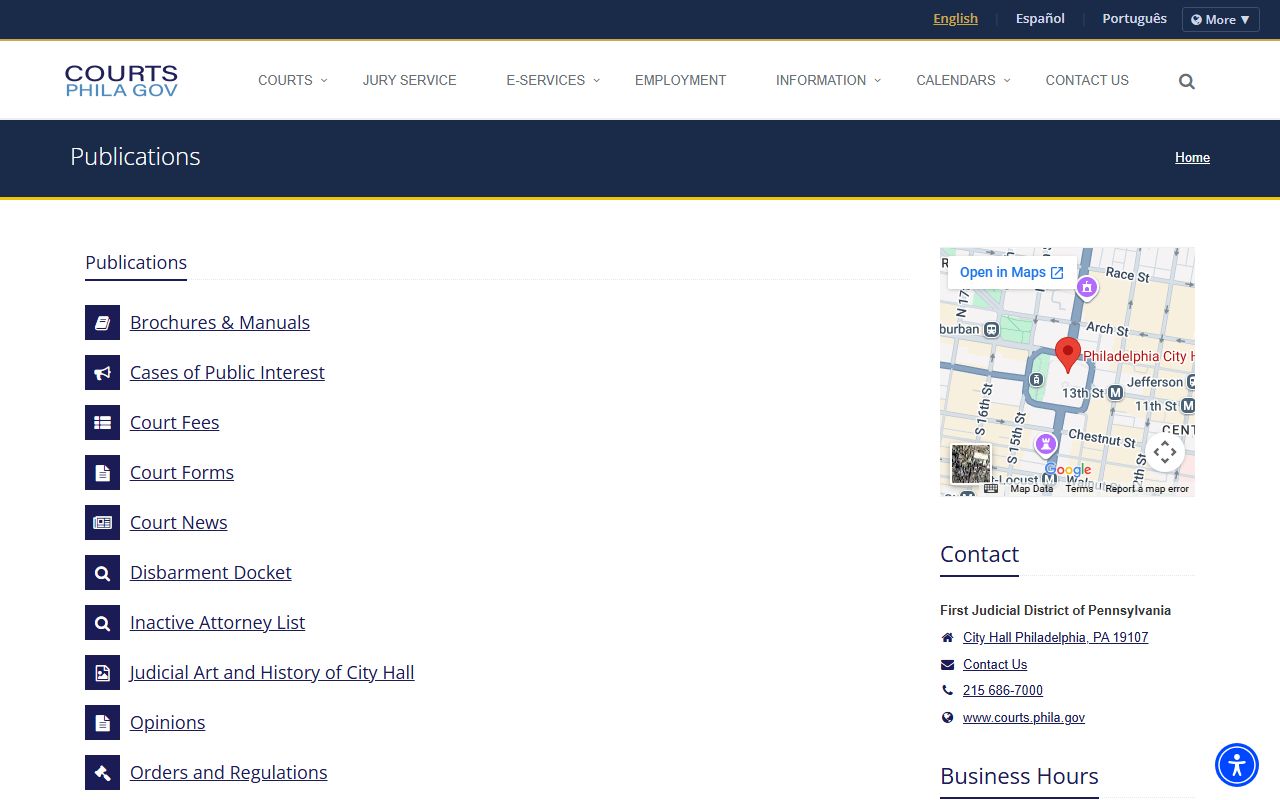
Fees can change, so confirm the current amount with the office before you mail a payment.
Philadelphia County Court Records Search Fields
The docket portals share a few common fields. You pick a court type first, then search by name or docket number. The table below lists the main fields you will see on the FJD case hub and the UJS criminal docket search.
| Field Label | Type | Required | Notes / Format |
|---|---|---|---|
| Court / docket type | Tab or link | Yes | Choose civil, criminal, family, Orphans' Court, Municipal, or traffic |
| Last name / organization | Text | Conditional | Required for a participant name search |
| First name | Text | No | Narrows common names |
| Docket number | Text | Conditional | Best if known; format varies by court |
| County | Dropdown | Conditional | Select Philadelphia for county results |
| Date filed range | Date | No | Narrows results where available |
How to Interpret Philadelphia County Court Records
Docket text uses short codes and legal terms. A "disposition" is the outcome of a charge or case. "Held for court" means a Municipal Court case moved up to Common Pleas. "Nolle prosequi" or "withdrawn" means the charge was dropped. A charge is not a conviction; only a guilty plea or a guilty verdict is a conviction. Bail entries show the amount and whether it was set, posted, revoked, or denied.
Because a felony can have a Municipal Court docket and a later Common Pleas docket, do not assume two dockets mean two crimes. Follow the OTN, the offense tracking number, to link related dockets for the same arrest.
Accuracy and Record Limitations
Online records lag real life. A docket updates after a clerk enters an event, so a recent hearing or a cleared warrant may not show right away. Snapshot data can carry errors, and some records are sealed or never posted online at all. If you spot a clerical error in your own case, the public-access policy lets a party or attorney send a written correction request to the proper custodian.
Note: Confirm any case detail with the First Judicial District or the holding office before you rely on an online record for a legal, housing, or job decision.
History of Philadelphia County Courts
Philadelphia's courts are among the oldest in Pennsylvania. The Court of Common Pleas traces back to the colonial charter and the Pennsylvania Constitution of 1776. The modern three-division structure, Trial, Family, and Orphans' Court, came from a 1968 amendment to the Constitution of 1874. The "Orphans' Court" name confuses people; it covers estates, trusts, and protected persons, not just children. In recent years, the MacArthur Safety and Justice Challenge from 2015 to 2025 helped cut the jail population sharply, and the city still publishes monthly population reports.
Frequently Asked Questions
How do I search Philadelphia County court records online?
Start at the First Judicial District Calendars & Case Information page. Pick the case type first, then search by name or docket number. Criminal cases use the statewide UJS Web Portal, while civil, family, Municipal, and Orphans' Court cases use the FJD docket links. The official court FAQ answers many filing and e-service questions too.
Are Philadelphia criminal dockets free?
Yes. Public docket sheets are free through the Pennsylvania UJS Web Portal. A docket shows the case number, parties, charges, bail and disposition events. It usually does not include free copies of every filing. For full documents you may need a clerk request or a courthouse visit.
Which court handles small claims in Philadelphia?
The Philadelphia Municipal Court Civil Division handles small claims up to $12,000, landlord-tenant cases, and code enforcement up to $15,000. Its public contact is 1339 Chestnut Street, 215-686-2910. Larger civil cases and appeals move to the Court of Common Pleas.
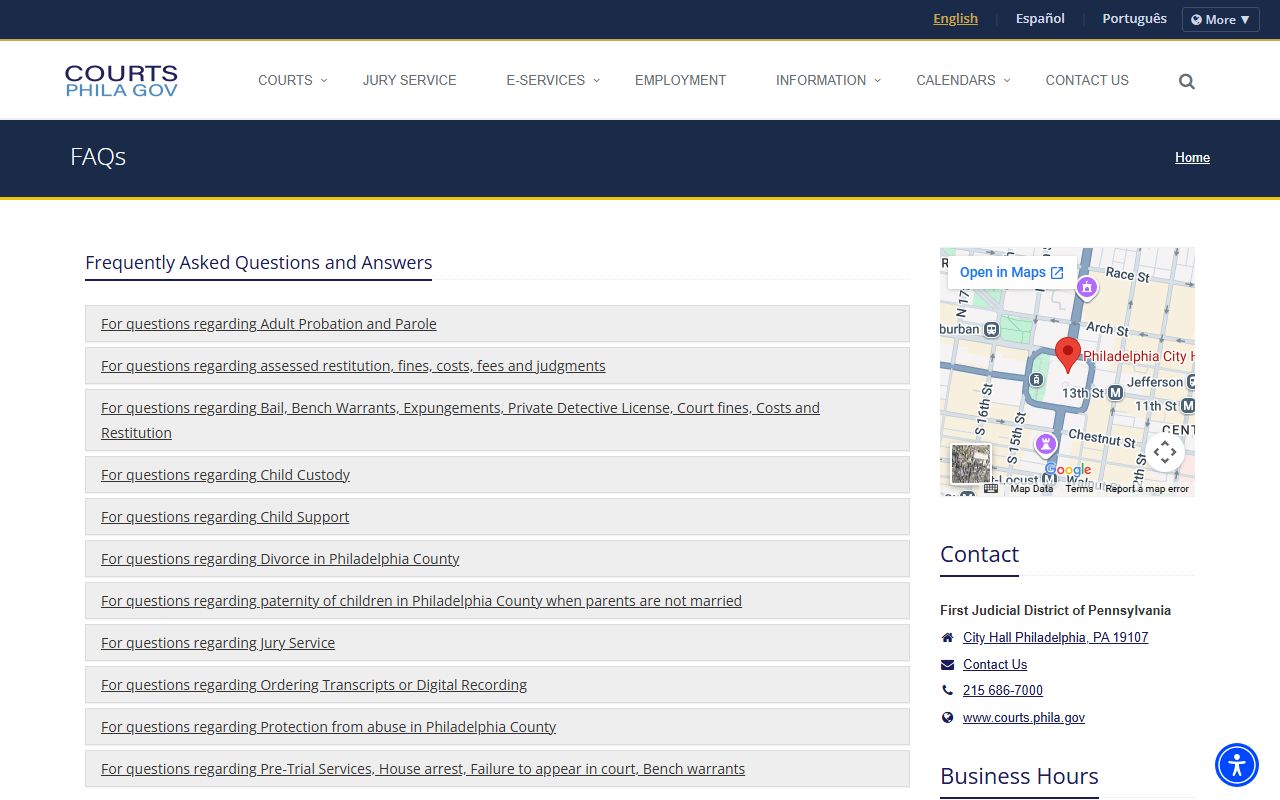
More on the Philadelphia County Court Records FAQ page, including the official source shown below.
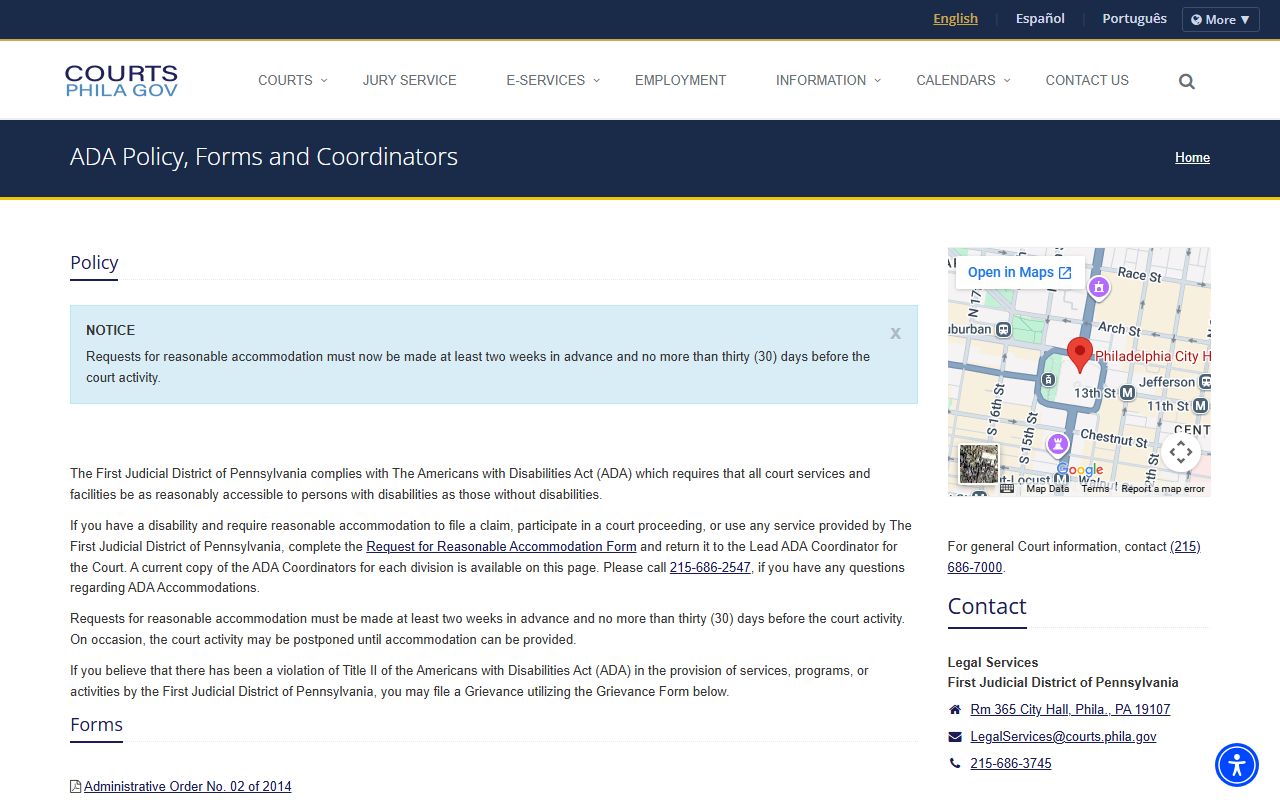
People with disabilities can request accommodations through the FJD ADA office, shown here, and named parties, witnesses, and victims have a right to a free interpreter.