
How to Use the Philadelphia County Inmate Locator
The official tool is the City of Philadelphia "Locate an incarcerated person" service. It searches only people held in Department of Prisons custody, so it will not find state or federal inmates. The search needs either a full name with a date of birth, or a police identification number, known as a PID. The result tells you which facility holds the person. For anything beyond that, the city directs users to the 24-hour inmate information lines and the Office of Community Justice and Outreach.
Before you start, gather what you know. A correct spelling and an accurate date of birth cut down on false matches, especially for common names. If you have paperwork with a PID, that is the cleanest way to search. The steps below follow the official workflow.
- Open the city inmate locator service.
- Enter a full name and date of birth, or a PID if you have it.
- Submit the search and read which facility is returned.
- Call the inmate information line for details the locator does not show.
- Set up a release notification if you want an alert when custody changes.
The city locator service page is shown below.
The screenshot is the City of Philadelphia find an inmate service.
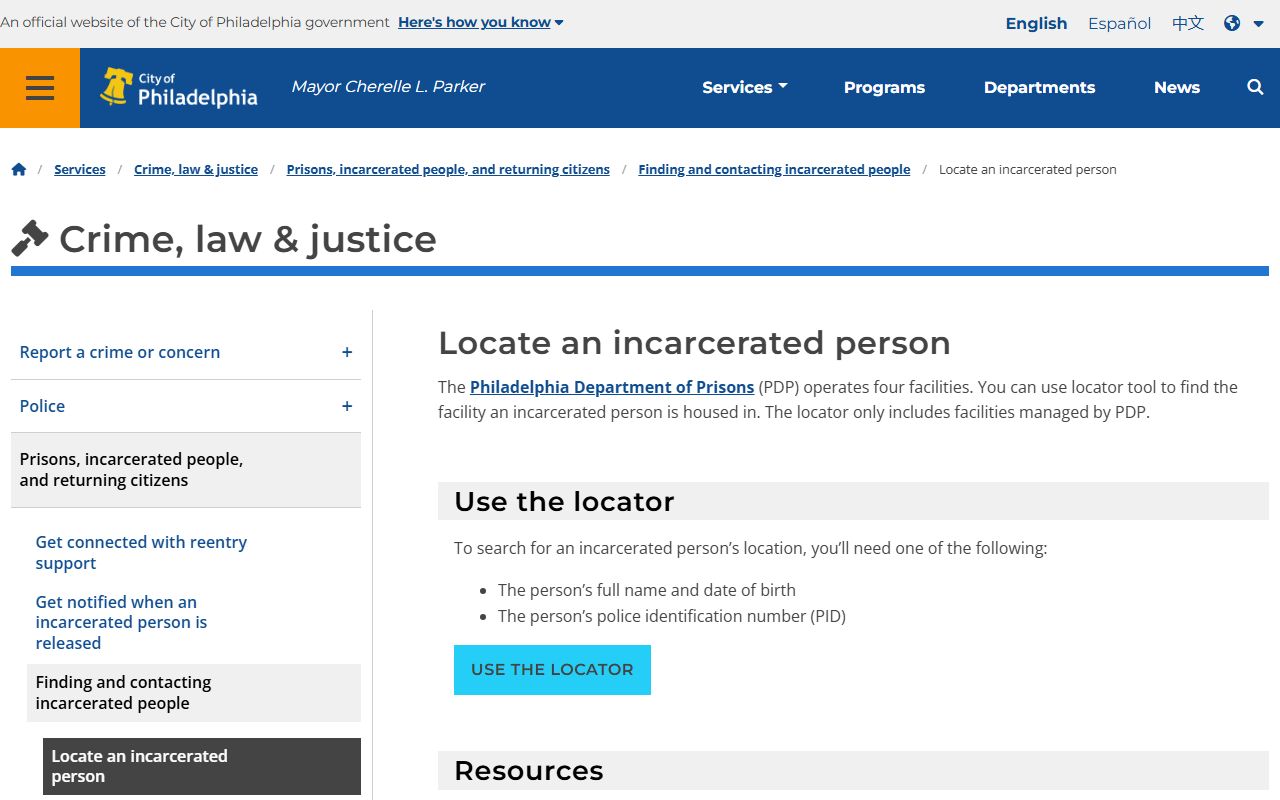
It is the official starting point for finding someone in Department of Prisons custody.
Philadelphia County Inmate Search Fields
The locator keeps its fields simple. You search by name with a date of birth, or by PID. There is no public option to browse a full roster, so the search needs at least one identifier. The table lists the fields and what each one requires.
| Field Label | Type | Required | Notes / Format |
|---|---|---|---|
| Full name | Text | Conditional | Required with date of birth if not using a PID |
| Date of birth | Date | Conditional | Required with full name |
| Police ID number (PID) | Text | Conditional | Alternative to name plus date of birth |
| Use the locator | Button | n/a | Opens the locator tool |
| Facility result | Output | n/a | Names the current Department of Prisons facility |
What the Locator Shows and Does Not Show
This is where Philadelphia differs sharply from counties that publish a full jail roster. The official locator finds the facility where a person is housed and little else. It does not post a mugshot, the charges, the bond amount, the housing pod, or a release date on the public service page. That is a real limit, and it means a public roster with photos and case detail is not how Philadelphia works. The fallback for more information is a phone call. The table shows what is and is not available.
| Field | Shown on the Public Locator? |
|---|---|
| Housing facility | Yes |
| Mugshot | No |
| Charges | No |
| Bond / bail amount | No |
| Booking number | No |
| Pod or housing unit | No |
| Release date | No |
For charges and case status, use the criminal docket instead. See Philadelphia County arrest records and court records for that side. This locator-only model is a deliberate design choice, not a missing feature. The official guidance says the tool finds the facility where a person is housed and directs users to phone lines or the Office of Community Justice and Outreach for anything more. So a reader who arrives expecting a full booking page with photos and bond should reset that expectation. The custody system and the court system are separate, and each answers a different half of the question.
Philadelphia Department of Prisons Facilities
The Department of Prisons operates four facilities, all clustered on State Road in the Northeast. Commissioner Michael R. Resnick leads the department, which provides a secure environment along with workforce, education, behavioral health, and substance-use services. Each facility serves a distinct role, so the locator's facility result tells you something about a person's status, such as whether they are in the medical unit. The Department of Prisons homepage is shown below.
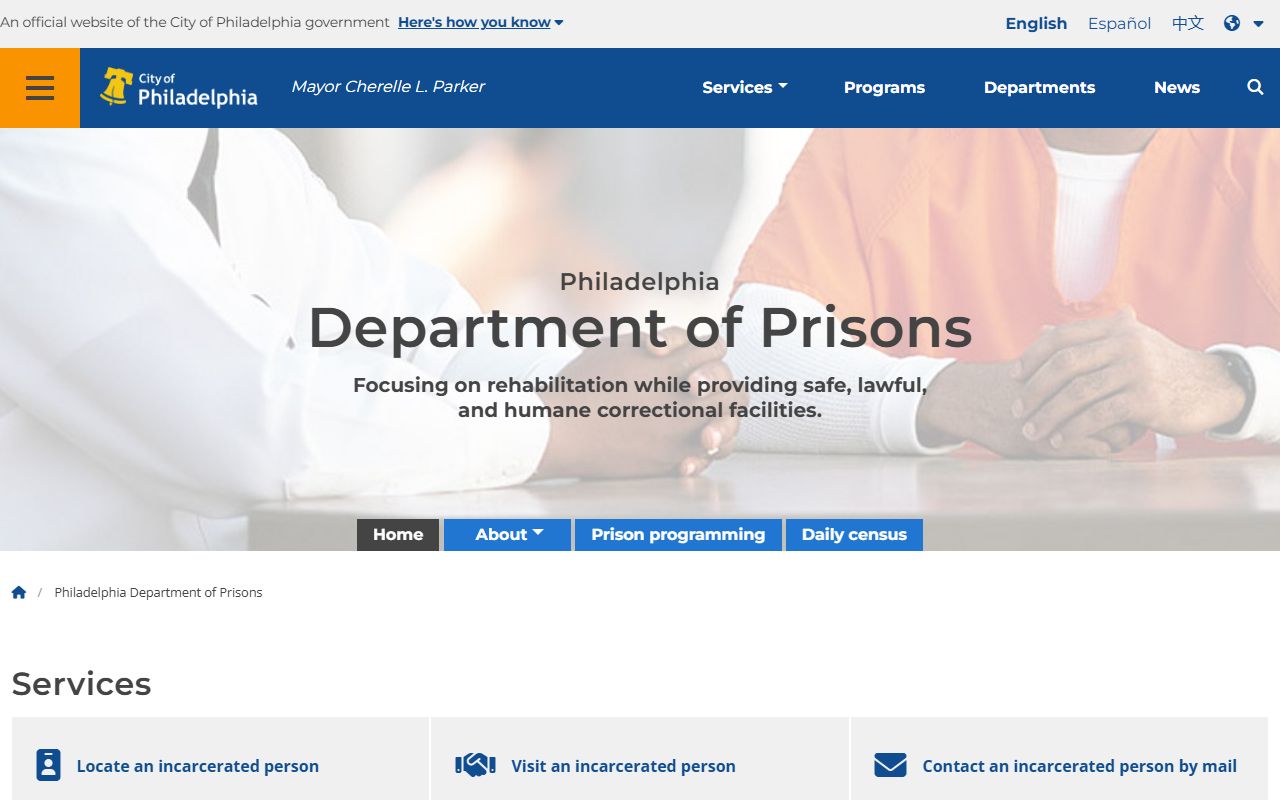
The official facilities page lists each building and its function. It appears here.
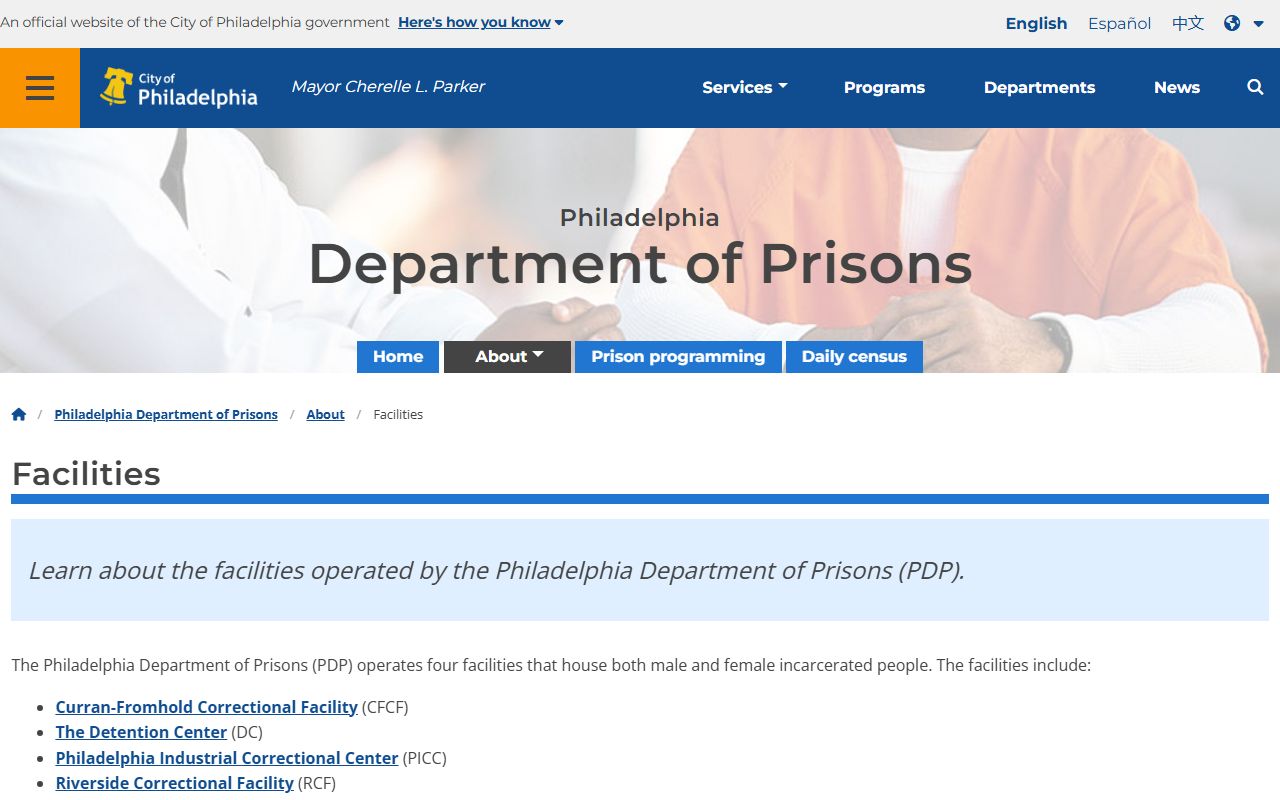
Curran-Fromhold opened in 1995 and is the largest facility, named for Warden Patrick N. Curran and Deputy Warden Robert F. Fromhold, killed in the line of duty at Holmesburg Prison in 1973. The Detention Center opened in 1963, replaced the old Moyamensing Prison as the intake center, and now serves as the medical unit with a 99-bed health services wing. The Industrial Correctional Center opened in 1986 as the first unit-management facility, and Riverside opened in 2004 with intake, discharge, treatment, and vocational areas. All four sit on State Road in the Northeast, far from the Center City courts, so a family may travel to one place for a visit and another for a hearing. The contact details for each facility follow.
Curran-Fromhold Correctional Facility
7901 State Rd.
Philadelphia, PA 19136
215-685-7843
Largest PDP facility
Detention Center
8201 State Rd.
Philadelphia, PA 19136
215-685-8436
Medical and behavioral health unit
Philadelphia Industrial Correctional Center
8301 State Rd.
Philadelphia, PA 19136
215-685-7100
13 unit-management housing units
Riverside Correctional Facility
8151 State Rd.
Philadelphia, PA 19136
215-685-6911
Intake, discharge, and treatment areas
Calling for Inmate Information
Because the locator shows so little, the phone lines matter more here than in most counties. The Department of Prisons runs 24-hour inmate information numbers at 215-685-8394, 215-685-8395, and 215-685-8396. Spanish-language service is available at 215-685-8692. For other questions about an incarcerated person, the Office of Community Justice and Outreach can be reached at 215-685-7288, 215-685-7711, and 215-685-8909.
These lines are the real workaround for the locator's limits. Staff can confirm whether a person is in custody and which facility holds them, and the Office of Community Justice and Outreach is the contact the city names for other information about an incarcerated person. Because the public page shows so little, treat the phone numbers as a core part of the search, not a last resort.
Note: Keep the person's full name and date of birth ready when you call, since staff need an identifier to look up the record.
Booking, Arraignment, and Bail
Custody in Philadelphia starts with the court process. Police make the arrest, and the Municipal Court Criminal Division processes every arrest in the county. The preliminary arraignment courtroom at the Stout Center runs 24 hours a day, every day. At arraignment, a judge addresses charges and bail. The Department of Prisons then receives the person, classifies housing, and provides medical and behavioral screening.
Bail can be paid through PAePay Bail, the official system maintained by the Unified Judicial System and linked from Department of Prisons resources. Bail eligibility and amount depend on the docket and current custody status. Some people are held without bail, with a detainer, or under non-monetary release conditions, so a payment alone does not always lead to release. Reading the criminal docket alongside the locator gives the fullest picture, because the docket carries the bail action and any detainer while the locator carries the current facility. Avoid private bond ads that promise quick release; the official path is the court docket and PAePay Bail.
Visitation Hours and Rules
Visits are appointment-only, and walk-ins are not allowed. An incarcerated person can receive visitors for one hour each week. Visits must be scheduled at least 48 hours ahead and no more than seven days out, and visitors should arrive at least 10 minutes early. No more than one adult and one child may visit at a time. Children six months and older can visit with a parent or guardian who shows proof of custody or a birth certificate, but not during school hours. The visitation page is shown below.
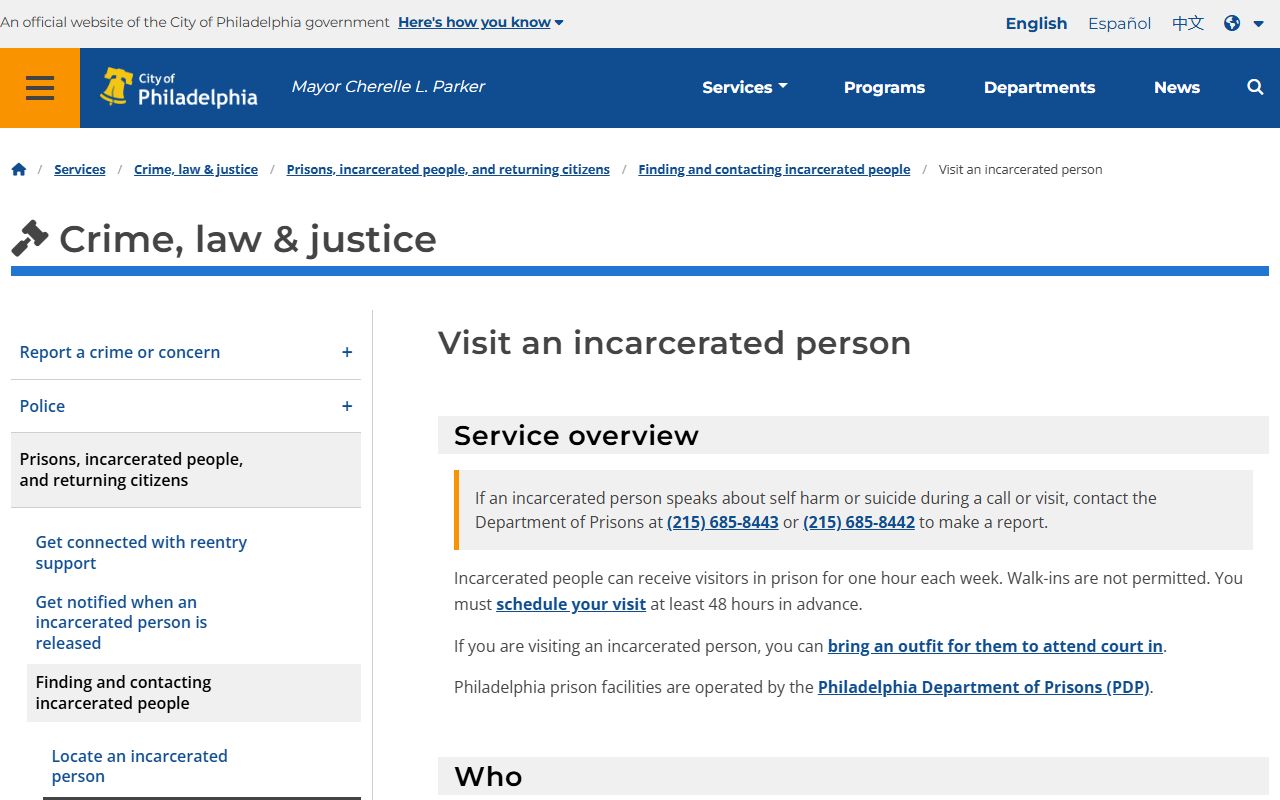
Schedule a visit at visitpdp.org, bring a government ID, and have the person's name and ID number ready. Lockers in the waiting area require quarters, and there is no change machine, so bring coins. Visitors go through a metal detector and may be searched in a private room. The weekday schedule is below.
| Facility | Days | Time Slots |
|---|---|---|
| Curran-Fromhold (CFCF) | Monday to Friday | 9-10 a.m.; 1-2 p.m.; 3-4 p.m. |
| Detention Center (DC) | Monday to Friday | 9-10 a.m.; 1-2 p.m.; 3-4 p.m. |
| Industrial Correctional Center (PICC) | Monday to Friday | 9-10 a.m.; 1-2 p.m.; 3-4 p.m. |
| Riverside (RCF) | Monday to Friday | 9-10 a.m.; 1-2 p.m.; 3-4 p.m. |
If a search seems improper, ask for a supervisor or contact the Office of Community Justice and Outreach at 215-685-8909 or 215-685-7288.
Mail, Funds, and Commissary
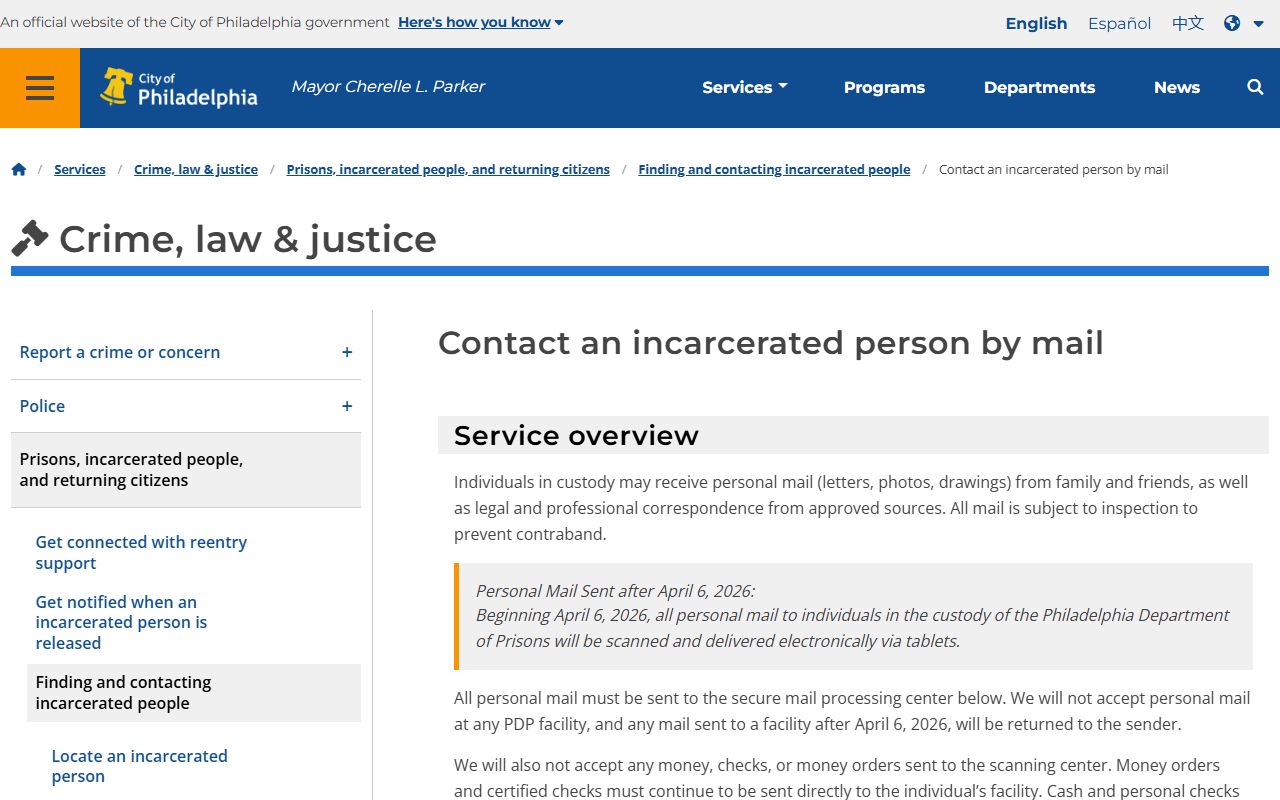
Since April 6, 2026, personal mail is scanned and delivered electronically through tablets. Personal mail must go to Philadelphia IPCS, PA, P.O. Box 247, Phoenix, MD 21131, with the person's name and PPN. The facilities no longer accept personal mail directly. Legal and professional mail is different: it must be clearly marked "Legal Mail" and sent directly to the facility. Letters must be on plain white paper in a plain white envelope, and photos must be 5x7 or smaller with no nudity, weapons, money, or drug use. The mail page is shown below.
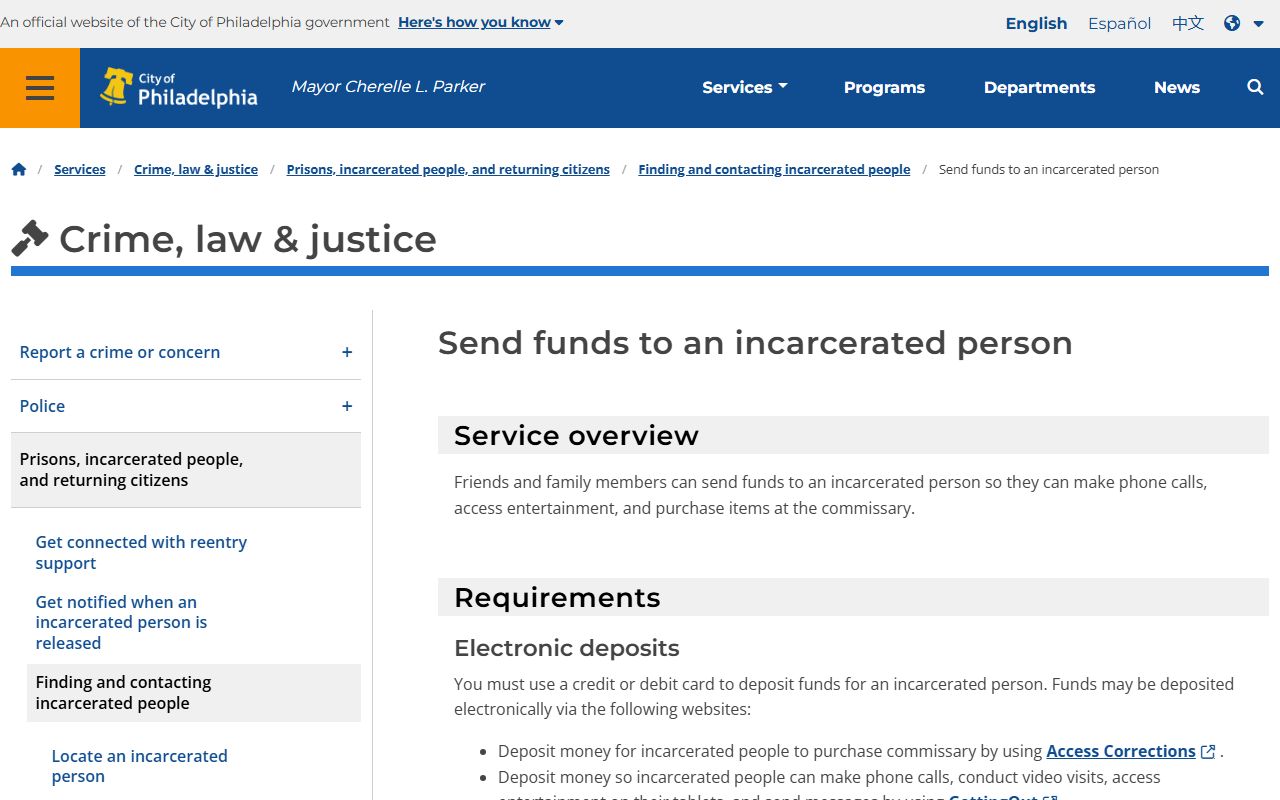
Money follows its own rules. Money orders and certified checks must go directly to the facility, not the scanning center, and must include the name, PPN, facility name, and address. Cash and personal checks are not accepted. The funds page links Access Corrections for commissary money and GettingOut for phone, video, and tablet funds. That page is shown next.
Sending money to the scanning center by mistake is a common error, so confirm the address before you send. The mail rules are strict in other ways too. Books, magazines, and newspapers must come directly from a third-party seller, hardback books are not allowed, and packages are not accepted. Letters cannot use crayons, markers, colored paper, glitter, or more than two stickers on the envelope. These rules exist for security, and mail that breaks them is returned, so following the format the first time avoids a long delay in reaching the person.
County vs State vs Federal Custody
The locator only covers county custody, so a missing result may mean the person is held elsewhere. State-sentenced inmates appear in the Pennsylvania Department of Corrections locator. Federal inmates appear in the Bureau of Prisons locator. Knowing which level holds a person points you to the right tool. For state and federal lookups, plus release verification, see released inmates.
Note: A person can move between levels over time, such as from county pretrial custody to a state prison after sentencing, so the correct locator can change.
Common Inmate Search Problems
Most failed searches come from small data issues. A misspelled name, a wrong date of birth, or a recent booking that has not posted yet can all return nothing. If the locator finds no match, try a name variant, double-check the date of birth, or call the inmate information line. Remember the locator only covers Department of Prisons facilities, so a person in state or federal custody will not appear no matter how you spell the name.
Timing also matters. A person arrested overnight may not appear until the booking is fully entered, and a transfer between facilities can briefly change the result. When in doubt, the 24-hour phone line is faster than repeated searches. For population data rather than a single person, see Philadelphia County jail population, and for warrants that may be driving custody, see warrant records.